


Feb
The Future of Business Software: API-first architecture, Microservices & Connected Ecosystems
The Shift Redefining Enterprise Software
Over the past fifteen years, I’ve watched the software industry undergo a fundamental transformation. Organisations winning in the marketplace have embraced a radically different philosophy: breaking down systems into small, independent services connected through APIs. This isn’t just technical innovation. It’s a strategic imperative that separates market leaders from those struggling to keep pace.
API-first architecture represents more than an engineering decision it’s how modern organisations maintain competitive advantage in rapidly changing markets. Companies ignoring this shift find themselves locked into inflexible systems. Those embracing it gain unprecedented agility, scalability, and market responsiveness.
Why API-First Architecture Matters
Moving to an API-first approach required painful organisational change, but it was essential. Traditional development built applications first, then tried to expose functionality through APIs. This backwards approach created brittle systems that couldn’t adapt to evolving requirements.
API-first development forces you to define APIs before writing code. You’re forced to think about contracts, consistency, and reusability from day one. Our engineering teams started asking better questions: “What is this service really responsible for?” “How do we make this composable?” “Can another team use this without knowing our implementation details?”
The discipline of API-first architecture shifted our thinking from feature developers to platform builders. This mindset change proved more valuable than any single technical implementation. We realised our APIs weren’t just technical plumbing they were our organisational interface, defining how teams interact and collaborate.
When APIs become first-class organisational concerns, something remarkable happens: engineering excellence accelerates. Teams develop deeper understanding of their responsibilities. Dependencies become explicit rather than hidden. System boundaries become clear.
Microservices: The Natural Evolution
API-first architecture naturally evolved toward microservices architecture for us. We moved from monolithic systems where changing one feature could destabilise everything toward small, independent services, each owning specific business capabilities.
The benefits became immediate and measurable:
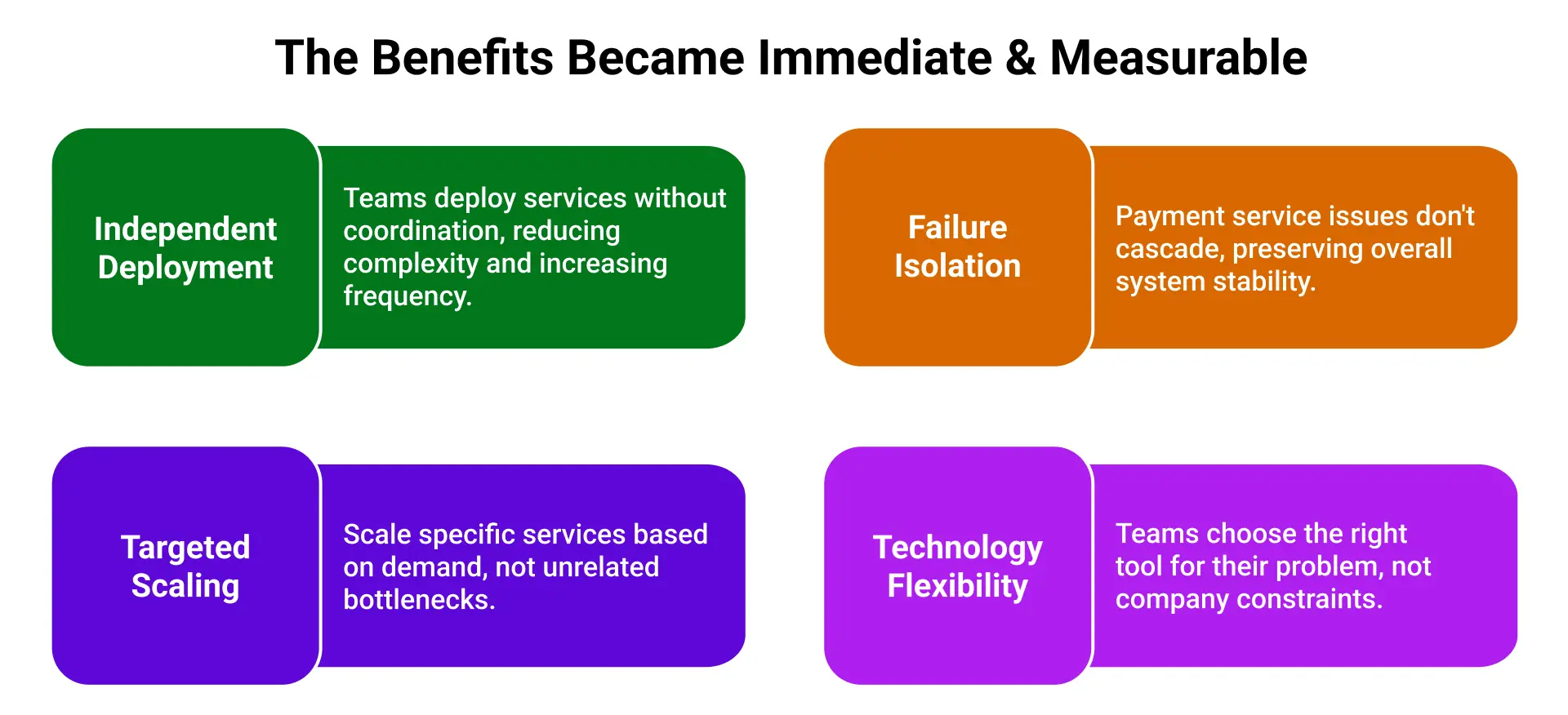
Independent Deployment – Teams deploy their services without coordinating across the entire organisation, reducing release complexity and increasing deployment frequency.
Failure Isolation – Payment service issues don’t cascade through your entire platform. Issues remain contained, preserving overall system stability.
Targeted Scaling – Scale specific services based on actual demand patterns, not bottlenecks in unrelated components.
Technology Flexibility – Teams choose the right tool for their specific problem instead of being locked into company-wide technology constraints.
The trade-off is straightforward: while you avoid monolithic architectural complexity, you take on operational complexity. Microservices require container orchestration, service discovery, distributed logging, and circuit breakers. Development in a microservices architecture also demands that teams understand distributed systems concepts not just coding skills. This operational burden is real and should not be underestimated.
Building Connected Data Ecosystems
Three years ago, we realised microservices architecture solved our engineering problem but created a business problem. Each service owned its data. Product teams couldn’t answer fundamental questions like “What’s happening across our entire customer lifecycle?” because insights were scattered across siloed databases.
That’s when we invested in building a connected data ecosystem a unifying layer bringing data from disparate services, applying governance, and making it accessible to those who need it.
A connected ecosystem comprises real-time data pipelines that extract data from microservices without requiring direct database access. This maintains security boundaries while enabling insights. Data governance frameworks define what data exists, who accesses it, and how it’s used. This organisational agreement on data stewardship proved as important as the technology itself.
Finally, AI and machine learning layers identify patterns across connected data that no human analyst would catch. Problems that seemed impossible became addressable once you connect your data ecosystem to intelligent systems.
Strategic API Design and Governance
An API strategy isn’t optional anymore it’s how you maintain strategic control of your technical direction. A real API governance framework does three critical things:
Business-First Planning: We stopped asking “Can we expose this through an API?” and started asking “Does this create strategic value?” Not every internal capability needs exposure. We prioritise APIs creating new revenue streams, enabling partner integrations, or improving customer experience fundamentally.
Standardised Design: We established API design patterns authentication approaches, error handling conventions, pagination standards that look consistent across our platform. This doesn’t restrict innovation; it accelerates it. New teams don’t debate how to handle errors. They use established patterns.
Lifecycle Management: We treat APIs as products with formal lifecycle processes: monitoring, performance analytics, and clear deprecation policies. An API is born, matures, gains versions, and eventually retires gracefully.
Developer Experience Drives Adoption
Building great APIs while burying them in poor documentation guarantees failure. If developers can’t discover, understand, and use your APIs easily, your API strategy fails entirely.
We invested in a comprehensive developer portal with complete documentation, SDKs in multiple languages, sandbox environments for safe testing, and real support channels. This isn’t about developer satisfaction it’s about organisational velocity. When developers self-serve instead of filing support tickets, your entire organisation moves faster.
Connected Ecosystems: Tomorrow’s Competitive Advantage
Platforms mastering ecosystem thinking will dominate their markets. Look at Salesforce. It’s not just CRM anymore it’s a 4,000-app ecosystem where DocuSign handles contracts, Tableau provides analytics, and Slack enables communication, all connected through APIs.
The more integrated these services become, the harder customers can leave. This is the future. Business software will be interconnected networks of specialised services, all speaking the same language through APIs. To compete, we’re building strategic partnerships where our API-first architecture integrates with complementary services, thinking constantly about how data and value flow across ecosystems.
Real Challenges Require Honest Solutions
API-first and microservices aren’t cure-alls. Three challenges require honest attention:
Organisational Alignment: Microservices require organisational evolution. Teams need autonomy but must follow shared standards. Explicit conversations about which standardisation actually matters versus “how we’ve always done it” are essential.
Operational Complexity: Running dosens of microservices is harder than one monolith. Monitoring, observability, and incident response require different skills and substantial investment.
Data Consistency: You can’t have ACID transactions across services like in a monolith. Understanding eventual consistency and designing around it is critical.
The Strategic Imperative
Organisations thriving in 2026 and beyond will commit to API-first architecture not as technical exercise but as strategic transformation. API-first development keeps you flexible. Microservices architecture enables graceful scaling. Connected ecosystems turn data into competitive advantage.
But none of this happens through technology alone. It requires investment in people, operational discipline, and organisational culture. You need teams understanding service boundaries, APIs as contracts, and distributed systems thinking.
Organisations investing in both technology and human sides will define the next decade of business software. The rest will gradually become irrelevant. The future isn’t coming. It’s already here you just need the architecture to match it.

Nihal Rajput is the Operations Director at Ficode Software Solutions Pvt. Ltd., where he oversees day-to-day operations, streamlines processes, and drives organisational efficiency. With a focus on delivering scalable solutions and maintaining operational excellence, he plays a key role in aligning teams, optimising resources, and ensuring client satisfaction as the company grows.

 Previous
 Next
Next