


Feb
Best API Integration Solutions for Healthcare: Secure & Compliant
The healthcare industry is evolving rapidly, and digital tools now play a crucial role in delivering efficient, accurate, and patient-centric care. But for any digital system to work effectively – whether it’s an EHR platform, a telemedicine app, or a patient portal, it needs strong, reliable connectivity beneath the surface. This is where Healthcare API Integration becomes essential.
APIs allow different healthcare systems to communicate with each other, share data securely, and support seamless care delivery. From improving clinical workflows to enhancing patient experiences, API integration is shaping the future of healthcare technology.
Why Healthcare API Integration Matters Today
Healthcare organisations handle a huge amount of data every day—appointments, medical histories, lab results, prescriptions, billing information, and more. Traditionally, these systems operated separately, making data access slow and inefficient.
With modern Healthcare API Integration, these systems can finally connect. Clinicians get complete patient information in one place, administrative staff save time, and patients benefit from faster, more accurate care.
Behind all these improvements is one key goal: creating a healthcare ecosystem where data flows easily and securely without the need for manual work or switching between disconnected platforms.
Security and Compliance: The Core of Reliable API Integration
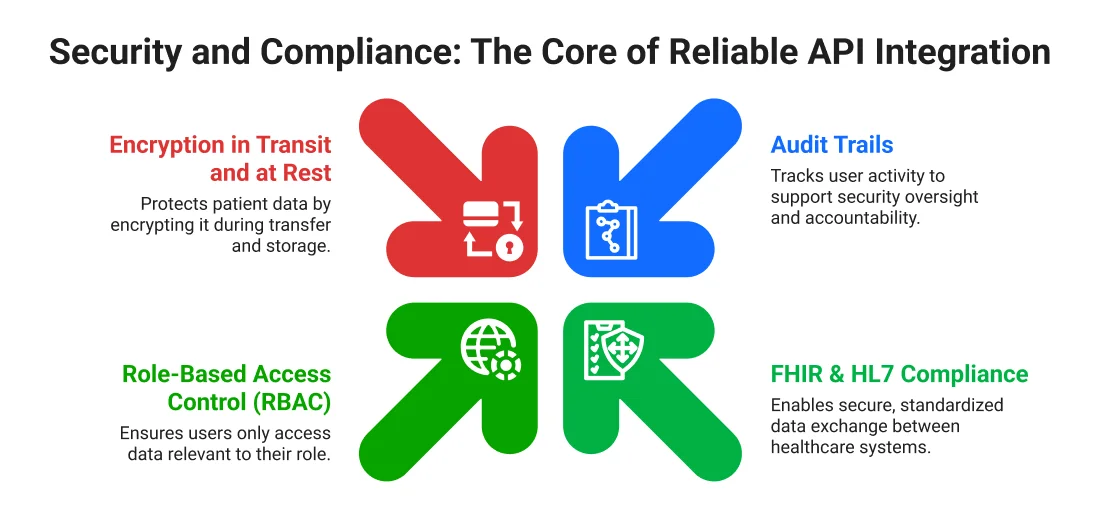
In healthcare, any form of digital integration must follow strict security and compliance standards. Security is the top priority when implementing Healthcare API Integration. Patient data is highly sensitive, and every exchange needs to be protected.
Here’s what makes an API integration secure and compliant:
1. Encryption in Transit and at Rest
All patient data must be encrypted before it moves between systems.
2. Role-Based Access Control (RBAC)
Only authorised individuals should access medical records and system features.
3. Audit Trails
A record of who accessed what data and when is essential for security monitoring.
4. FHIR & HL7 Compliance
These frameworks ensure health systems exchange data in a standardised and secure way.
When these measures are in place, data moves safely between systems, and healthcare providers stay compliant without disrupting their daily workflows. Healthcare organisations should always prioritise Secure API integration to protect their data and meet regulatory obligations.
Connecting EHRs, Patient Tools, and Telemedicine Platforms
One of the most powerful uses of Healthcare API Integration is bringing core clinical systems together with modern digital tools. This includes EHRs, patient-facing applications, and telehealth platforms—each of which plays a vital role in today’s care delivery.
EHR Connectivity for Streamlined Workflows
EHRs are the backbone of healthcare operations, and their ability to communicate with other tools can dramatically improve care coordination. For example, scheduling systems, lab software, pharmacy platforms, and clinical apps all need to access patient data stored in EHRs.
This is why many providers depend on EMR/EHR integration services, ensuring that medical data moves smoothly and stays consistent across platforms.
Better Engagement Through Patient Portals
Patient portals have become a standard expectation. They allow patients to see test results, track prescriptions, message providers, manage appointments, and more.
APIs help connect these portals with backend clinical systems. When a doctor updates an EHR, the information instantly appears in the patient portal – no delays, no extra work. This level of transparency builds trust and helps patients stay engaged in their care.
Telemedicine APIs for Virtual Care
Telemedicine solutions rely heavily on API connectivity. Video consultations, remote monitoring tools, digital prescriptions, and online billing all need access to real-time data.
By integrating these systems securely, healthcare providers can offer virtual care that feels just as reliable as in-person visits. This type of Healthcare API Integration is now essential for clinics and hospitals aiming to grow their digital offerings.
Integrating Third-Party Healthcare Tools
As digital healthcare expands, organisations often need to connect with external services – insurance platforms, diagnostics labs, medical devices, wearables, payment systems, and more.
This is where Third-party healthcare API integration becomes valuable. It brings different tools into one ecosystem, reducing administrative tasks and creating a more connected patient experience.
For example:
- Lab results can automatically appear in a doctor’s dashboard
- Wearable device data can sync with patient records
- Insurance claims can be submitted instantly
- Pharmacy orders can be updated in real time
These integrations help healthcare providers remove repetitive tasks and focus more on patient care.
Choosing the Right API Integration Partner
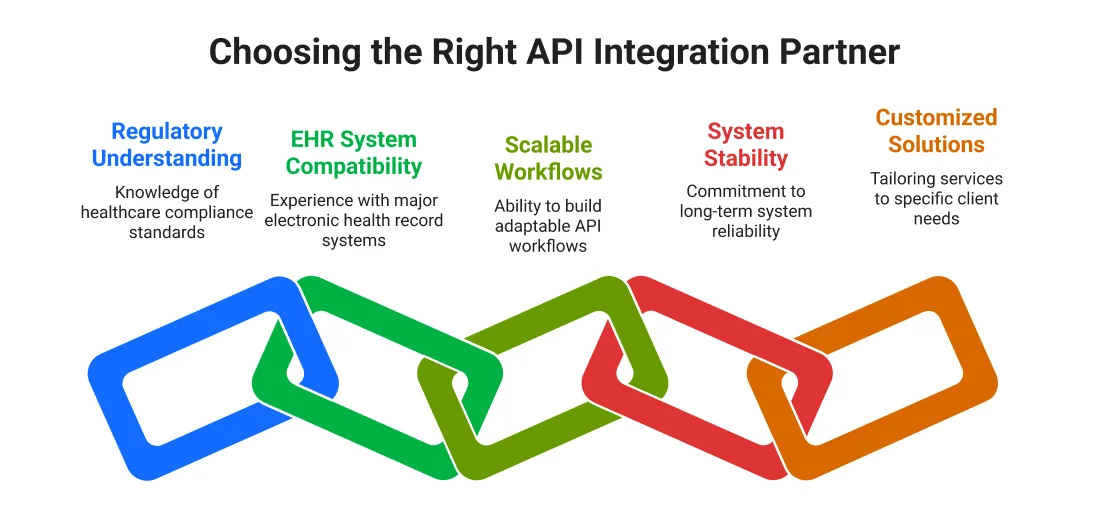
Since healthcare integrations require deep technical knowledge and a strong understanding of compliance standards, it’s important to choose a partner with proven experience. The right team will:
- Understand healthcare regulations
- Work with major EHR systems
- Build scalable API workflows
- Maintain long-term system stability
- Create customised solutions based on your needs
With the right support, Healthcare API Integration becomes a long-term asset that powers growth, innovation, and better patient outcomes.
Final Thoughts
As the healthcare industry continues to evolve, API integration will remain one of the most important foundations of digital transformation. From patient portals and telemedicine platforms to EHR systems and third-party tools, every modern healthcare solution depends on seamless and secure data exchange.
Investing in strong, compliant, and well-designed API integration not only strengthens operations, it improves the entire patient’s experience. And for healthcare providers looking to grow in an increasingly digital world, that’s a competitive advantage that truly matters.

Nihal Rajput is the Operations Director at Ficode Software Solutions Pvt. Ltd., where he oversees day-to-day operations, streamlines processes, and drives organisational efficiency. With a focus on delivering scalable solutions and maintaining operational excellence, he plays a key role in aligning teams, optimising resources, and ensuring client satisfaction as the company grows.

 Previous
 Next
Next