


Jul
Common AI Development Mistakes and How to Avoid Them

Artificial Intelligence is no longer a futuristic concept, it’s a practical tool businesses are actively using to improve efficiency, automate processes, and make better decisions. However, despite its growing adoption, many organisations still struggle to get AI projects right.
From poor planning to unrealistic expectations, AI development mistakes can lead to wasted time, budget overruns, and failed implementations. The good news? Most of these mistakes are avoidable with the right approach.
Despite significant investments in Artificial Intelligence, many AI projects fail to deliver the expected business outcomes. Common challenges such as unclear objectives, poor data quality, integration issues, and unrealistic expectations can quickly derail even the most promising initiatives. Understanding these pitfalls early can help organisations reduce risk, improve project success rates, and maximise the value of their AI investments.
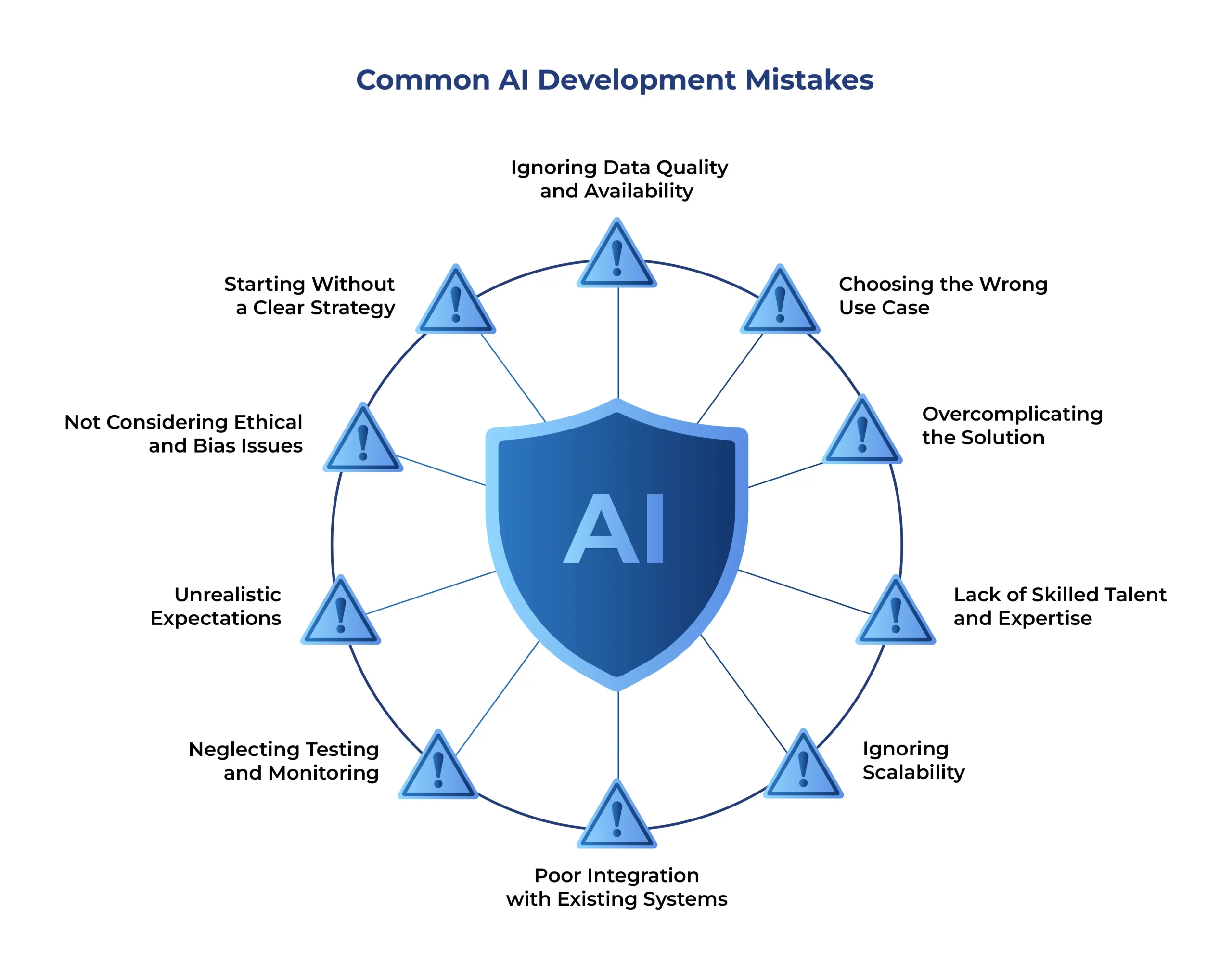
1. Starting Without a Clear Strategy
One of the most common AI development mistakes is implementing AI without clearly defined business objectives. Many organisations rush into AI adoption to keep up with market trends, only to discover that their projects lack direction, measurable outcomes, or alignment with business priorities. Without a clear strategy, AI initiatives often struggle to demonstrate value and achieve long-term success.
Without a proper roadmap, AI initiatives often lose direction and fail to deliver measurable results.
How to Avoid It
Before starting, ask:
- What problem are we solving with AI?
- How will success be measured?
- Does this align with business goals?
A clear strategy ensures that your AI investment delivers real value instead of becoming an expensive experiment.
2. Ignoring Data Quality and Availability
AI systems are only as good as the data they are trained on. Poor-quality, incomplete, or biased data can lead to inaccurate predictions and unreliable outputs.
Many AI implementation mistakes stem from underestimating how important clean and structured data is.
How to Avoid It
- Invest time in data collection and cleaning
- Ensure data is relevant and unbiased
- Regularly update datasets
Data serves as the foundation of every AI model. If the data is incomplete, inaccurate, or biased, the resulting predictions, insights, and business decisions are likely to be unreliable.
3. Choosing the Wrong Use Case
Not every problem needs AI. Sometimes, a simple rule-based system or traditional software solution can do the job more effectively.
Trying to force AI into the wrong use case is one of the most overlooked AI development mistakes.
How to Avoid It
- Evaluate whether AI is truly needed
- Start with high-impact, achievable use cases
- Focus on problems where AI can provide clear value
The goal is not to use AI everywhere, but to use it where it makes sense.
4. Overcomplicating the Solution
Many teams assume that more complex models will automatically deliver better results, which is . In reality, overly complex AI systems can be harder to train, maintain, and scale.
This often leads to delays and increased costs.
How to Avoid It
- Start with simple models and scale gradually
- Focus on performance, not complexity
- Continuously test and improve
In many cases, a well-designed, streamlined AI solution delivers better performance, lower maintenance requirements, and faster business value than an overly complex model.
5. Lack of Skilled Talent and Expertise
AI development requires specialised knowledge, including data science, machine learning, and system integration. Without the right expertise, projects can quickly go off track.
This is where many businesses struggle, especially when trying to build solutions in-house without adequate experience.
How to Avoid It
- Invest in hiring or training skilled professionals
- Partner with experienced AI development specialists who can provide strategic guidance, technical expertise, and implementation best practices.
- Consider leveraging custom AI solutions tailored to your needs
Working with experienced teams can significantly reduce risk and improve outcomes.
6. Poor Integration with Existing Systems
Even a well-built AI model can fail if it doesn’t integrate properly with existing business systems. Integration challenges are a common cause of AI deployment mistakes.
If AI tools don’t fit seamlessly into workflows, adoption becomes difficult.
How to Avoid It
- Plan integration early in the development process
- Ensure compatibility with current systems
- Test thoroughly before deployment
AI should enhance your existing processes, not disrupt them.
7. Ignoring Scalability
Many AI projects work well in testing environments but fail when scaled to real-world usage. This happens when scalability is not considered from the beginning.
How to Avoid It
- Design systems with scalability in mind
- Use auto-scaling services (ex – AWS Auto Scaling ) to handle traffic spikes
- Adopt microservices architecture so individual components can scale independently
- Load test your AI model before deployment using tools like Locust or k6
- Cache model predictions for frequently repeated inputs to reduce compute load
- Use a message queue (like Kafka or RabbitMQ) to manage high-volume inference request
- Monitor performance as usage grows
A scalable solution ensures long-term success and avoids costly rebuilds.
8. Unrealistic Expectations
AI is powerful, but it’s not magic. Expecting instant results or perfect accuracy can lead to disappointment and project abandonment.
This is one of the most common mindset-related AI implementation mistakes.
How to Avoid It
- Set realistic goals and timelines
- Understand that AI improves over time
- Focus on continuous learning and optimisation
AI success is a journey, not a one-time achievement.
9. Neglecting Testing and Monitoring
Launching an AI model is not the end – it’s just the beginning. Without proper testing and ongoing monitoring, performance can degrade over time.
How to Avoid It
- Continuous tracking of model performance
- Update models with new data
- Identify and fix issues proactively
Regular monitoring ensures your AI system remains accurate and reliable.
10. Not Considering Ethical and Bias Issues
AI systems can unintentionally inherit biases from training data, leading to unfair or inaccurate outcomes. Ignoring this can harm both users and your brand reputation.
How to Avoid It
- Use diverse and representative datasets
- Regularly audit models for bias
- Implement ethical AI practices
Responsible AI development builds trust and long-term credibility.
Final Thoughts
Avoiding AI development mistakes is not about perfection – it’s about preparation, awareness, and continuous improvement. From defining a clear strategy to ensuring proper deployment, every step in the process matters.
By addressing these common challenges early, businesses can unlock the true potential of AI while minimising risks and avoiding critical AI development mistakes.
Whether you’re just starting or looking to improve existing systems, focusing on best practices and learning from past mistakes can make all the difference. And with the right approach and the right AI Development services, you can build solutions that are not only innovative but also practical and scalable.
If you’re planning to implement AI or want to avoid costly mistakes, partnering with an experienced team like Ficode can help you build reliable, scalable, and result-driven AI solutions tailored to your business needs.

Nihal Rajput is the Operations Director at Ficode Software Solutions Pvt. Ltd., where he oversees day-to-day operations, streamlines processes, and drives organisational efficiency. With a focus on delivering scalable solutions and maintaining operational excellence, he plays a key role in aligning teams, optimising resources, and ensuring client satisfaction as the company grows.

 Previous
 Next
Next