


Feb
CRM & ERP API Integration: The Best Way to Unify Business Data
In most growing businesses, different teams rely on different tools. Sales teams use CRM platforms to track leads, while finance and operations depend on ERP systems to manage inventory, billing, and internal processes. Both systems are essential—but when they operate separately, data becomes scattered, duplicated, and difficult to manage.
This is exactly where CRM & ERP API Integration becomes incredibly valuable. By connecting both systems through APIs, businesses can create a unified flow of information that improves accuracy, boosts productivity, and supports smarter decision-making.
Why Connecting CRM and ERP Matters for Modern Businesses
As companies scale, they start generating more data than they can manage manually. Sales data, invoices, customer records, product availability, delivery updates—every department collects important information. But if these details are not connected, the business suffers from:
- Repeated manual entry
- Delayed access to updated customer information
- Disconnected sales and finance teams
- Errors in orders, pricing, or inventory
- Slower response time to customer needs
With CRM & ERP API Integration, all these issues become easier to manage. Instead of jumping between two different systems, your teams can work with consistent, real-time information in one connected environment.
How CRM & ERP API Integration Actually Works
APIs act as bridges between two platforms. When you integrate your CRM with your ERP, information flows automatically between the systems. For example:
- When a new customer is added in the CRM, it appears instantly in the ERP
- When an invoice is generated in the ERP, the status updates in the CRM
- When inventory changes in the ERP, sales teams immediately see the stock update
This creates a single source of truth, which is extremely important for businesses trying to grow without losing operational efficiency.
Many companies use specialised CRM ERP integration services to ensure the connection is secure, scalable, and tailored to their unique workflows.
Real Benefits of Unifying CRM and ERP Data
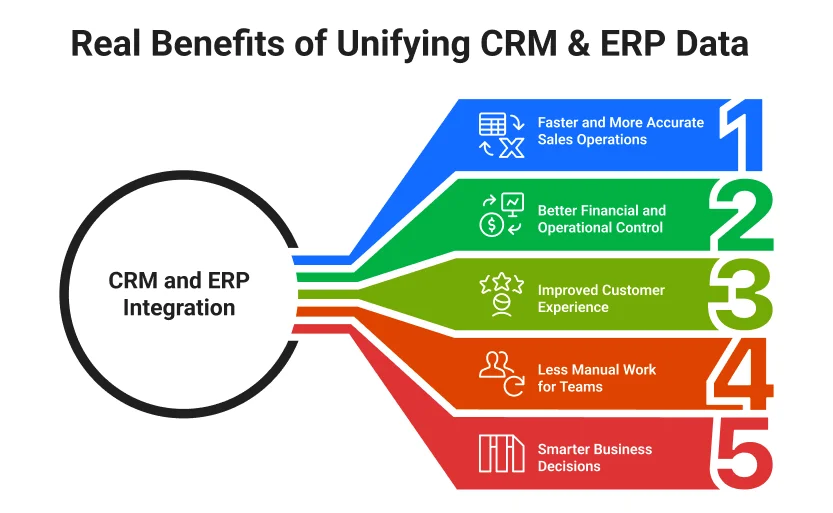
When your two core business systems are connected, the advantages quickly become obvious. Some of the biggest benefits include:
1. Faster and More Accurate Sales Operations
Sales teams get immediate access to product availability, pricing rules, and customer history. This helps them respond faster, avoid errors, and offer customers the right information from the start.
2. Better Financial and Operational Control
Finance teams can track orders, payments, and customer accounts without waiting for updates from sales. This reduces delays and helps businesses stay on top of cash flow.
3. Improved Customer Experience
When customer data is synced, both sales and support teams can handle issues quickly. Whether it’s checking an order status or accessing purchase history, everything stays updated.
4. Less Manual Work for Teams
The biggest hidden cost for growing businesses is manual data entry. Integrating CRM and ERP systems removes duplicate work and frees up teams to focus on tasks that actually drive revenue.
5. Smarter Business Decisions
With real-time, connected data, founders and business owners can clearly see sales performance, product movement, customer behavior, and financial trends—all in one place.
Why API-Driven Integration Is the Best Approach
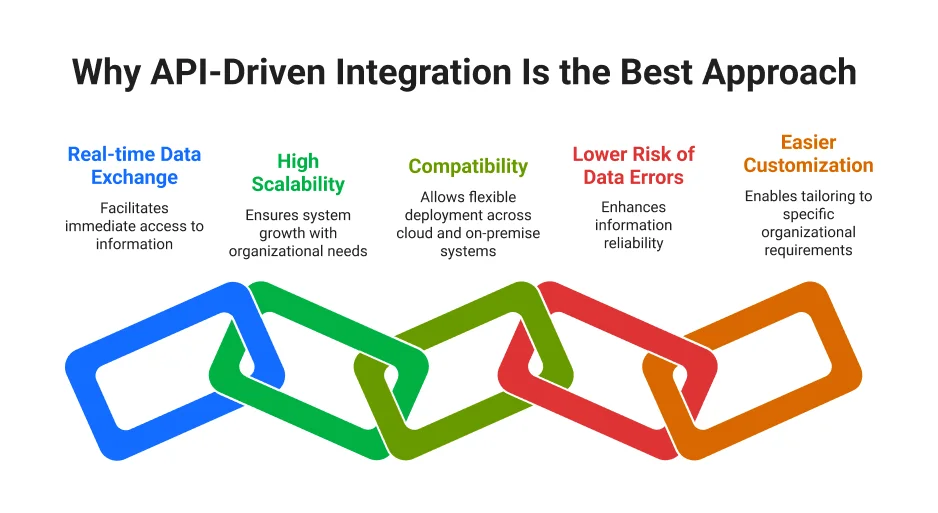
There are different ways to connect a CRM and ERP, but using APIs is the most modern and flexible option. With API-based connectivity, your business gets:
- Real-time data exchange
- High scalability
- Compatibility with cloud and on-premise systems
- Lower risk of data errors
- Easier customisation
Modern API integration solutions are built to grow with your business and adapt to new tools over time. And if your systems are cloud-based, you can even benefit from advanced Cloud API integration that supports remote teams and multi-location operations.
Use Cases Where CRM & ERP API Integration Makes a Huge Difference
While every business benefits from connected systems, some industries feel the impact even more:
- Manufacturing – sync inventory, supply chain details, and order management
- E-commerce – streamline product listings, stock levels, and fulfillment
- Retail – stabilise pricing, promotions, and customer data
- Professional services – track proposals, projects, billing, and customer communication
Regardless of the industry, the goal is the same: connect sales and operations so the business runs smoothly without constant manual updates.
Is CRM & ERP API Integration Right for Your Business?
If your teams frequently switch between CRM and ERP systems, rely on manual updates, or deal with repeated inconsistencies, integration can dramatically improve efficiency. It’s especially valuable for businesses planning to scale, expand into new markets, or automate their processes.
With the right technical team or partner, API integration can be done without disrupting your existing workflows. Once connected, the improvement in speed, accuracy, and transparency becomes noticeable almost immediately.
Final Thoughts
In a fast-moving business environment, disconnected systems slow your growth. CRM & ERP API Integration offers one of the most effective ways to unify your data, simplify operations, and support better decision-making across the entire organisation. By connecting these two essential platforms, businesses can work smarter, serve customers better, and stay ahead in a competitive market.
If you’re ready to connect your CRM and ERP systems and build a streamlined, data-driven workflow, our integration experts can help.
Contact us today to discuss your API integration needs and explore the best solution for your business.

Nihal Rajput is the Operations Director at Ficode Software Solutions Pvt. Ltd., where he oversees day-to-day operations, streamlines processes, and drives organisational efficiency. With a focus on delivering scalable solutions and maintaining operational excellence, he plays a key role in aligning teams, optimising resources, and ensuring client satisfaction as the company grows.

 Previous
 Next
Next