


Jun
AWS Implementation Roadmap: From Planning to Deployment
Moving to the cloud is no longer just a trend – it’s a business necessity. Among cloud platforms, AWS stands out as one of the most reliable and scalable options. However, simply deciding to use AWS is not enough. Without a clear plan, organisations often face delays, cost overruns, and performance issues.
This is where a well-defined AWS Implementation Roadmap becomes essential. It helps businesses move from initial planning to successful deployment in a structured and efficient way.
Let’s break down the complete journey step by step.
Understanding the AWS Implementation Roadmap
An AWS Implementation Roadmap is a structured plan that guides organisations through the entire cloud adoption process – from assessing current infrastructure to deploying and optimising workloads on AWS.
It ensures that every stage of the migration is aligned with business goals, technical requirements, and budget considerations. Instead of rushing into cloud adoption, businesses can follow a clear path that reduces risks and improves outcomes.
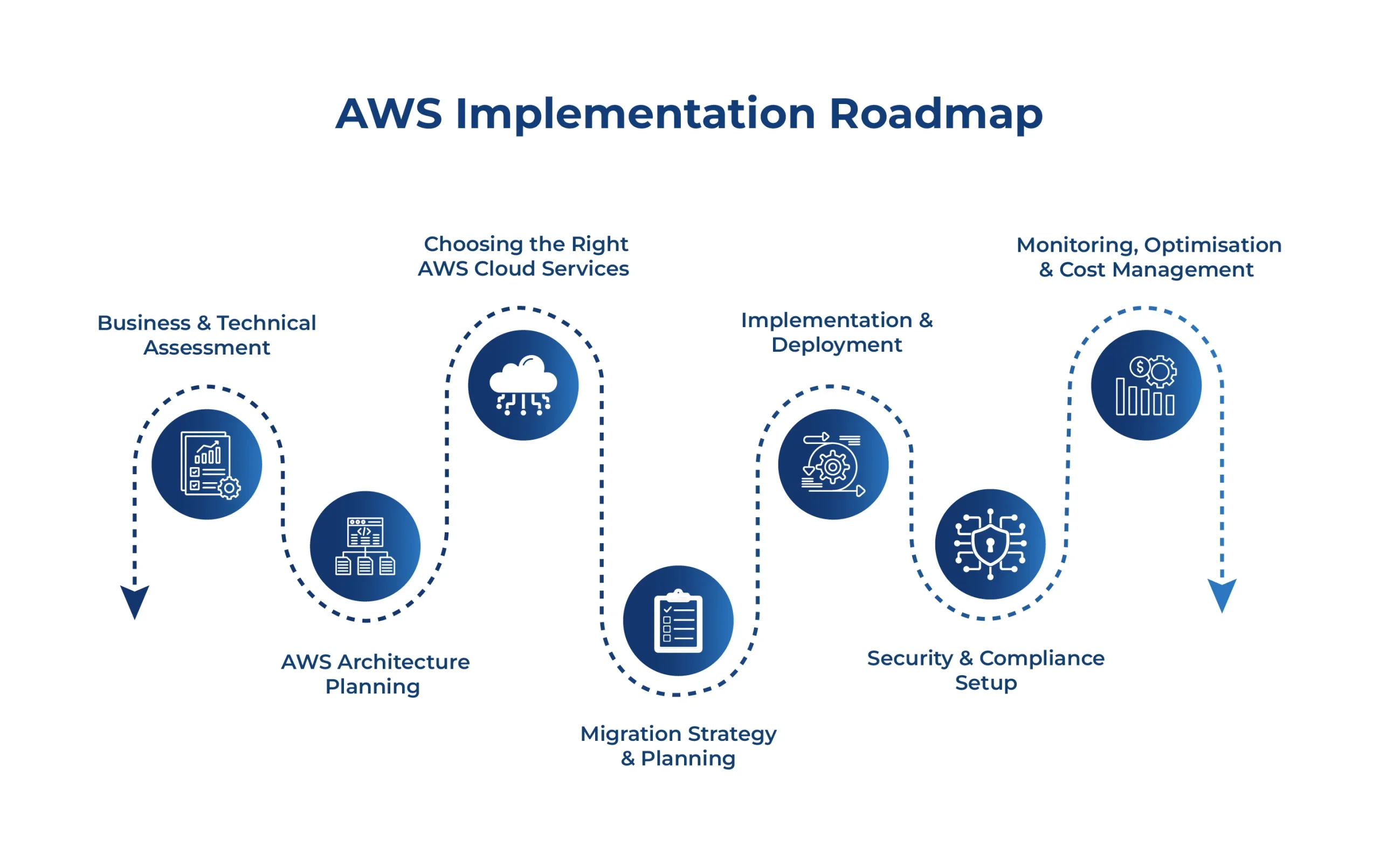
Step 1: Business & Technical Assessment
The first step in any AWS implementation is understanding where you currently stand.
This includes analysing your existing infrastructure, applications, and workloads. You need to identify which systems are suitable for migration and which may require modification or replacement.
At this stage, businesses also define their goals, whether it’s cost reduction, scalability, improved performance, or faster deployment cycles.
A proper assessment sets the foundation for all future aws implementation steps, ensuring that decisions are based on real data rather than assumptions.
Step 2: AWS Architecture Planning
Once the assessment is complete, the next step is designing your cloud architecture.
AWS architecture planning involves selecting the right services, defining network structures, and ensuring security from the ground up. This is where you decide how your applications will run on AWS.
Key considerations include:
- Choosing the right compute services (EC2, Lambda, etc.)
- Setting up storage solutions (S3, EBS)
- Designing networking (VPC, subnets, gateways)
- Planning for scalability and load balancing
A well-designed architecture ensures that your system is not only functional but also future-ready.
Step 3: Choosing the Right AWS Cloud Services
AWS offers a wide range of tools and solutions, but not every service is necessary for every business.
Selecting the right AWS Cloud services is critical for performance and cost efficiency. The choice depends on your application type, workload requirements, and long-term goals.
For example:
- Startups may prefer serverless options for flexibility
- Enterprises may require container-based or hybrid setups
- Data-heavy applications may need advanced analytics and storage services
Making the right choices at this stage prevents unnecessary complexity and reduces operational costs later.
Step 4: Migration Strategy & Planning
With architecture and services defined, the next step is to plan the migration itself.
This is where you create a detailed AWS migration roadmap, outlining how and when each workload will move to the cloud.
Common migration strategies include:
- Rehosting (lift and shift)
- Replatforming (minor optimisations)
- Refactoring (re-architecting applications)
Each approach has its own advantages, depending on time, budget, and technical constraints.
Proper planning ensures minimal downtime and avoids disruption to business operations.
Step 5: Implementation & Deployment
Now comes the execution phase – the actual AWS deployment process.
During this stage, applications, databases, and workloads are moved to AWS based on the migration plan. Infrastructure is set up, configurations are applied, and systems are tested to ensure everything works as expected.
Key activities include:
- Setting up cloud environments
- Deploying applications
- Configuring security and access controls
- Running performance and load testing
A smooth deployment ensures that your systems are stable, secure, and ready for real-world usage.
Step 6: Security & Compliance Setup
Security should never be an afterthought in cloud implementation.
AWS provides strong built-in security features, but they need to be configured correctly. This includes identity and access management, data encryption, and compliance with industry standards.
Businesses must ensure:
- Proper user roles and permissions
- Data protection mechanisms
- Compliance with regulations like GDPR or industry-specific standards
A secure environment builds trust and protects your business from potential threats.
Step 7: Monitoring, Optimisation & Cost Management
Deployment is not the end – it’s the beginning of continuous improvement.
Once your system is live, you need to monitor performance, optimise resources, and manage costs effectively.
This includes:
- Tracking system performance
- Scaling resources based on demand
- Identifying unused or underutilised services
- Implementing cost-saving strategies
Cost optimisation is especially important, as unmanaged cloud environments can quickly become expensive.
Common Challenges in AWS Implementation
Even with a roadmap, businesses may face certain challenges:
- Lack of cloud expertise
- Poor planning and unclear goals
- Security misconfigurations
- Unexpected costs
- Downtime during migration
These challenges highlight the importance of having a structured approach and, in many cases, expert guidance.
Why Businesses Consider AWS Consulting Services
For many organisations, managing the entire implementation process internally can be overwhelming.
This is why businesses often rely on AWS consulting services. Experienced professionals can help with planning, architecture design, migration, and optimisation.
They bring:
- Technical expertise
- Proven strategies
- Faster implementation timelines
- Reduced risks
While not always mandatory, consulting support can significantly improve the success rate of your cloud journey.
Final Thoughts
A successful cloud journey doesn’t happen by chance, it requires careful planning, the right tools, and a clear execution strategy.
An effective AWS Implementation Roadmap helps businesses move confidently from planning to deployment while minimising risks and maximising performance.
By following structured AWS implementation steps, focusing on strong architecture, and optimising post-deployment, organisations can fully unlock the potential of AWS.
Whether you are just starting or looking to improve your existing setup, having a roadmap ensures that every decision is aligned with your long-term business goals.
If you’re looking for expert guidance to streamline your AWS journey, Ficode’s AWS specialists can help you plan, implement, and optimise your cloud infrastructure with confidence.

Nihal Rajput is the Operations Director at Ficode Software Solutions Pvt. Ltd., where he oversees day-to-day operations, streamlines processes, and drives organisational efficiency. With a focus on delivering scalable solutions and maintaining operational excellence, he plays a key role in aligning teams, optimising resources, and ensuring client satisfaction as the company grows.

 Previous
 Next
Next