


Aug
AWS Cost Optimisation: Best Practices for 2026
AWS has become the backbone of modern digital infrastructure, helping businesses scale faster, deploy applications globally, and innovate without heavy upfront investment. However, as organisations grow on the cloud, one challenge becomes unavoidable -managing and controlling AWS spending effectively.
Without proper visibility and optimisation, AWS costs can increase quickly due to unused resources, poor architecture decisions, or lack of monitoring. This is where AWS Cost Optimisation becomes essential. It is not just about reducing expenses but about ensuring every dollar spent on AWS delivers maximum performance and value.
In this blog, we will explore the best practices for AWS cost optimisation in 2026, along with practical strategies, tools, and techniques that businesses can use to control cloud spending efficiently.
What is AWS Cost Optimisation?
AWS Cost Optimisation is the process of managing and reducing cloud expenses while maintaining performance, scalability, and reliability of applications. It involves analysing usage patterns, eliminating waste, selecting the right pricing models, and continuously monitoring cloud resources.
AWS provides a pay-as-you-go model, which is highly flexible. However, without optimisation, businesses often end up paying for:
- Underutilised compute resources
- Idle storage volumes
- Over-provisioned infrastructure
- Inefficient architectural setups
Effective cost optimisation ensures that resources are used efficiently and aligned with business needs.
Why AWS Cost Optimisation is Important in 2026
With increasing cloud adoption, AWS environments are becoming more complex. Companies now run multiple services like compute, storage, databases, analytics, and AI workloads simultaneously.
Without proper management, cloud spending can grow unpredictably. That’s why AWS cost optimisation best practices are critical for modern businesses.
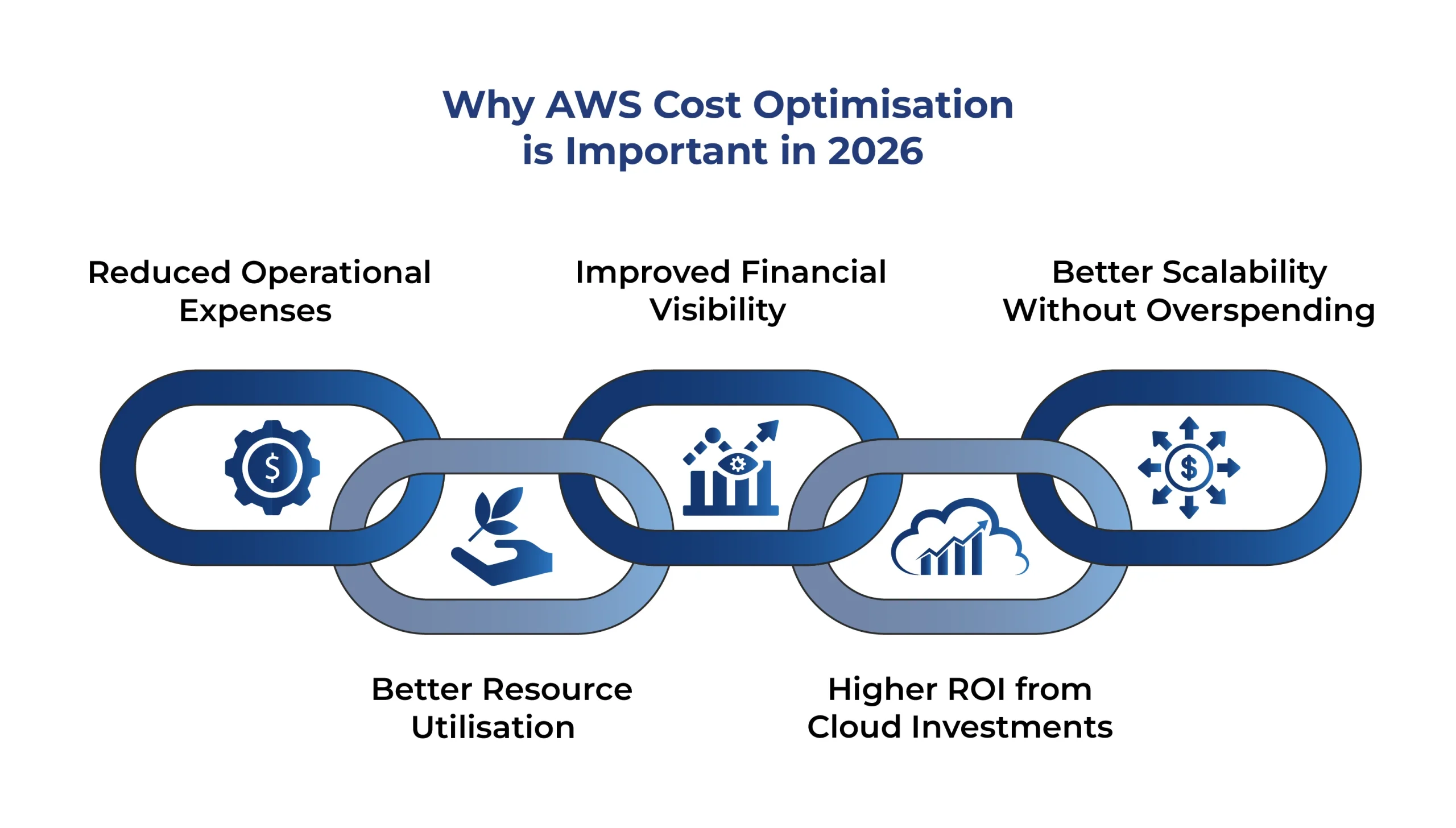
Key benefits include:
- Reduced operational expenses
- Better resource utilisation
- Improved financial visibility
- Higher ROI from cloud investments
- Better scalability without overspending
AWS Cost Optimisation Best Practices
Below are the most effective strategies businesses can use to optimise AWS costs in 2026.
1. Use AWS Savings Plans for Predictable Workloads
AWS Savings Plans are one of the most effective ways to reduce AWS costs for predictable workloads.
Instead of paying on-demand prices, businesses commit to a consistent usage level and receive significantly discounted rates in return.
This approach is ideal for applications with stable traffic patterns, such as production environments or always-on services. It helps organisations achieve long-term savings without compromising flexibility.
2. Choose the Right AWS Pricing Model
AWS offers multiple pricing models, and selecting the right one is essential for cost efficiency. The AWS pricing model includes options like on-demand pricing, reserved instances, and savings plans.
Each model serves a different purpose:
- On-demand is best for short-term or unpredictable workloads
- Reserved instances are suitable for long-term stable usage
- Savings plans offer flexible discounts for committed usage
A wrong pricing choice can significantly increase cloud spending, making this decision a key part of AWS cost optimisation.
3. Auto Scaling for Better Resource Utilisation
Auto Scaling in AWS ensures that your infrastructure dynamically adjusts based on real-time demand.
Instead of running fixed-capacity servers, Auto Scaling increases resources during peak traffic and reduces them during low usage periods.
This eliminates unnecessary infrastructure costs and ensures that businesses only pay for what they actually use, making it a core optimisation strategy.
4. Optimising S3 Storage with Intelligent Tiering
Storage costs can silently increase over time if not managed properly. Using Amazon S3 Intelligent-Tiering helps businesses automatically move data between storage classes based on access patterns.
For example:
- Frequently accessed data stays in high-performance storage
- Rarely accessed data moves to lower-cost tiers automatically
When combined with lifecycle policies, businesses can significantly reduce long-term storage expenses without manual intervention.
5. Using Spot Instances for Cost-Efficient Compute
Amazon EC2 Spot Instances allow businesses to use unused AWS capacity at much lower prices.
These are best suited for:
- Batch processing workloads
- CI/CD pipelines
- Machine learning model training
- Non-critical background tasks
Since these workloads are flexible and can handle interruptions, Spot Instances provide massive cost savings compared to traditional compute options.
6. Reducing Data Egress Costs Through Better Architecture
One of the most overlooked cost factors in AWS is data transfer, especially data moving out of AWS or between regions.
To reduce these costs, businesses should:
- Keep services within the same AWS region whenever possible
- Use caching mechanisms to reduce repeated data transfer
- Optimise API responses and payload sizes
- Avoid unnecessary cross-region communication
Even small architectural improvements in this area can lead to significant cost savings over time.
7. Right-Sizing AWS Resources
Many organisations over-provision cloud resources to avoid performance risks, but this leads to unnecessary spending.
Right-sizing involves analysing actual usage patterns and adjusting compute and storage resources accordingly. This ensures that infrastructure matches real workload requirements without waste.
It is one of the simplest yet most effective cost optimisation techniques.
8. Eliminating Ghost Resources
Over time, AWS environments accumulate unused resources such as idle EC2 instances, unattached volumes, and forgotten load balancers.
These are often referred to as “ghost resources” because they continue generating costs without delivering value.
Regular audits help identify and remove these resources, improving overall AWS cloud cost management and reducing unnecessary expenses.
Conclusion
AWS Cost Optimisation is not a one-time task but an ongoing process that requires continuous monitoring, planning, and adjustment. With the right strategies such as Savings Plans, Auto Scaling, cost monitoring, and resource optimisation, businesses can significantly reduce cloud expenses while maintaining high performance.
In 2026, organisations that actively manage their AWS environments will not only save costs but also gain better scalability, efficiency, and operational control.
If your business is struggling with rising AWS costs or wants to build a more efficient cloud setup, Ficode can help you design and implement a cost-optimised AWS infrastructure tailored to your needs.

Nihal Rajput is the Operations Director at Ficode Software Solutions Pvt. Ltd., where he oversees day-to-day operations, streamlines processes, and drives organisational efficiency. With a focus on delivering scalable solutions and maintaining operational excellence, he plays a key role in aligning teams, optimising resources, and ensuring client satisfaction as the company grows.
 Previous
 Next
Next