


Jan
API Integration Checklist: What to Consider Before Starting Your Project

Starting an API integration project without proper planning can lead to performance issues, security risks, and long-term maintenance challenges. APIs play a critical role in connecting systems, sharing data, and enabling automation, which is why a structured API integration checklist is essential before development begins.
In this guide, we’ll walk through the key aspects of API integration planning, including security, testing, performance, and ongoing maintenance, to help you build a stable and scalable integration from the start.
1. Define the Purpose of Your API Integration
The first step in API integration planning is understanding exactly what you want to achieve. Every integration should solve a specific business problem, whether it’s processing payments, syncing customer data, or enabling real-time reporting.
Clearly defined objectives form the foundation of an effective API integration checklist, helping teams make better technical decisions and avoid unnecessary complexity later.
Key questions to consider:
- What business problem does this integration solve?
- Who will use the integrated feature?
- What does success look like?
- What are the timeline and budget constraints?
Having clear answers ensures that your API integration effort remains focused and aligned with business goals.
2. Choose the Right API for Your Requirements
Selecting an API should be based on suitability, not popularity. While widely used APIs can be reliable, they may not always match your technical or business needs.
One of the most important indicators of API quality is documentation. Well-maintained APIs usually provide clear examples, error explanations, and active support resources.
Things to evaluate when choosing an API:
- Up-to-date and well-structured documentation
- Pricing that aligns with your expected usage
- Proven uptime and service-level agreements (SLAs)
- Availability of SDKs for your technology stack
- Realistic rate limits
- Support options or active developer communities
Choosing the right API early can prevent integration challenges later.
3. Prioritize API Security from the Start
API security best practices should be implemented from day one. APIs often handle sensitive business and customer data, making them a common target for attacks.
Security should never be treated as an afterthought.
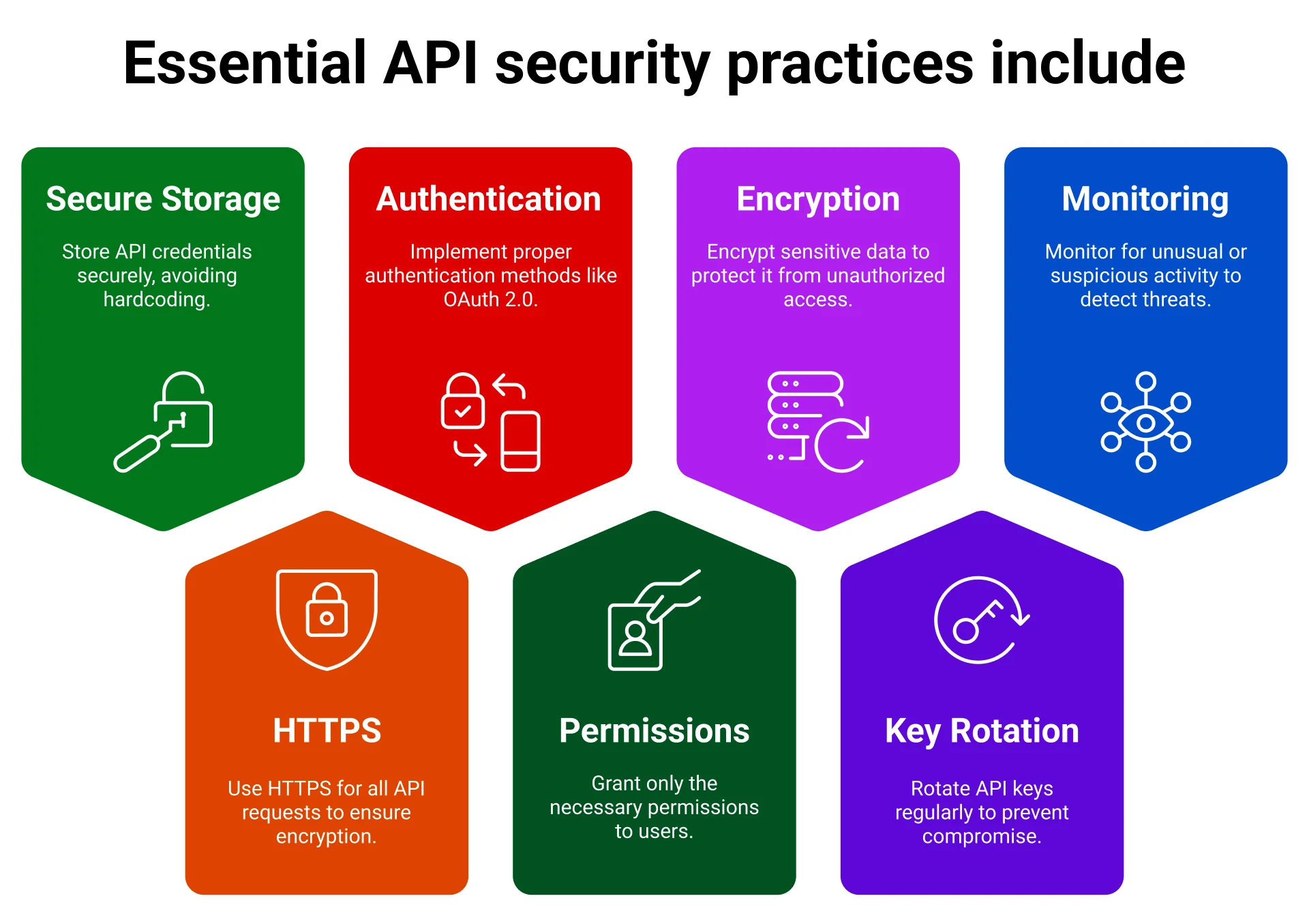
Essential API security practices include:
- Secure storage of API credentials (avoid hardcoding)
- Using HTTPS for all API requests
- Implementing proper authentication methods such as OAuth 2.0
- Granting only necessary permissions
- Encrypting sensitive data
- Rotating API keys regularly
- Monitoring for unusual or suspicious activity
A strong security foundation protects both your systems and your users.
4. Implement Effective API Testing Strategies
API testing strategies are critical to ensure reliability in real-world conditions. Testing should go beyond basic functionality and cover potential failure scenarios.
APIs may experience slow responses, downtime, or rate limiting, and your integration should be prepared to handle these situations gracefully.
API testing checklist:
- Test all core workflows and expected use cases
- Validate error handling and failure responses
- Test under slow network conditions
- Simulate rate-limit scenarios
- Use sandbox or staging environments when available
- Perform load testing with realistic traffic volumes
Thorough testing reduces the risk of unexpected issues after deployment.
5. Plan for API Performance Optimization Early
API performance optimization is much easier to manage during the planning phase than after launch. An integration that performs well at low traffic may struggle as usage grows.
Planning for performance ensures a smoother user experience and better scalability. Following an API integration checklist at this stage helps teams identify potential bottlenecks before they impact real users.
Performance optimization tips:
- Cache frequently requested data where appropriate
- Use asynchronous API calls to prevent blocking
- Batch requests when supported by the API
- Set reasonable timeout values
- Continuously monitor response times
- Prepare for future traffic growth
Optimizing performance early helps maintain stability as your application scales.
6. Design Robust Error Handling Mechanisms
Failures are inevitable in API integrations, whether due to network issues or service outages. Effective error handling ensures that these failures do not disrupt the entire system.
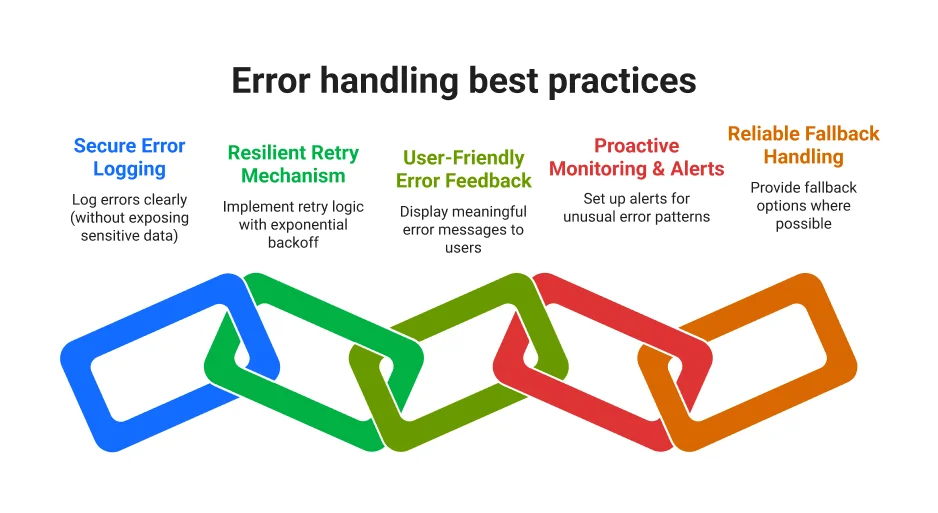
Error handling best practices:
- Log errors clearly (without exposing sensitive data)
- Implement retry logic with exponential backoff
- Display meaningful error messages to users
- Set up alerts for unusual error patterns
- Provide fallback options where possible
Well-designed error handling improves reliability and simplifies troubleshooting.
7. Maintain Clear and Practical Documentation
Good documentation is essential for long-term maintainability. It helps current and future team members understand how the integration works and how to update or troubleshoot it.
Documentation should cover:
- Setup and configuration steps
- Authentication methods
- Example API requests and responses
- Common errors and solutions
- Required environment variables
- Support or escalation contacts
Clear documentation saves time and reduces dependency on individual team members.
8. Plan for Ongoing Monitoring and Maintenance
API integration does not end at launch. APIs evolve, versions change, and performance can degrade over time without monitoring.
Ongoing maintenance checklist:
- Monitor uptime and response times
- Track error rates and failures
- Stay informed about API updates or deprecations
- Keep dependencies up to date
- Review and optimize integrations regularly
Proactive monitoring helps identify issues before they impact users.
Final Thoughts
A well-planned API integration is more secure, scalable, and easier to maintain. By following this API integration checklist and focusing on planning, security, testing, performance, and documentation, businesses can avoid common pitfalls and build integrations that deliver long-term value.
At Ficode, successful API projects consistently follow a structured approach before development begins. Taking the time to plan properly helps teams build reliable integrations that support business growth rather than hinder it.
Use this checklist as a foundation, adapt it to your specific requirements, and approach API integration with clarity and confidence.
If you’re planning an API integration project or need expert support to ensure secure, scalable implementation, Ficode can help. Our team specializes in API integration planning, development, and optimization tailored to your business needs. Get in touch with Ficode to discuss your integration requirements with confidence.

Nihal Rajput is the Operations Director at Ficode Software Solutions Pvt. Ltd., where he oversees day-to-day operations, streamlines processes, and drives organisational efficiency. With a focus on delivering scalable solutions and maintaining operational excellence, he plays a key role in aligning teams, optimising resources, and ensuring client satisfaction as the company grows.

 Previous
 Next
Next