

Jan
How to Choose the Best API Integration Partner: 12-Point Checklist

Choosing the Best API Integration Partner can make or break your digital transformation efforts. Whether you’re building a new product, connecting third-party tools, or automating internal workflows, the right partner ensures your systems work smoothly and securely.
But with so many companies offering API integration services, how do you know which one truly fits your business needs?
To make this process easier, here is a simple and practical 12-point API integration checklist that will help you evaluate the right partner with confidence.
1. Check Their Experience With Similar Integrations
Start by reviewing the partner’s past projects. Have they worked with businesses in your industry? Do they understand the type of APIs you need—REST, SOAP, GraphQL, or custom ones?
A partner with relevant experience will deliver results faster and more accurately.
2. Review Their Technical Skills
A reliable API team should be strong in languages and frameworks like JavaScript, .NET, PHP, Python, Node.js, and modern cloud platforms.
Their technical foundation tells you how well they can handle complex flows, authentication methods, and scalability.
3. Ask About Custom API Solutions
Your business needs are unique, which is why the partner should be able to build or modify APIs according to your requirements.
Companies that deliver Custom API solutions can help you automate specific tasks, improve communication between systems, and create new digital capabilities.
4. Evaluate Their Understanding of Your Business Goals
The Best API Integration Partner is not just a technical vendor – they act as a strategic advisor.
They should ask questions about your workflows, goals, user experience, and long-term plans before suggesting any solution.
If they don’t try to understand your business, they won’t be able to design the right integration flow.
5. Check Their Approach to Security
API security is non-negotiable. Ask how they protect data, prevent unauthorized access, and handle token-based authentication.
A strong partner should be familiar with encryption standards, OAuth, API gateways, and secure coding practices.
This point alone can save you from huge risks.
6. Analyze Their Project Management Style
Smooth project execution depends on clear communication and structured processes.
Ask about their project management system—how they share updates, track tasks, and manage timelines.
The Best API Integration Partner will always follow a transparent and organized workflow.
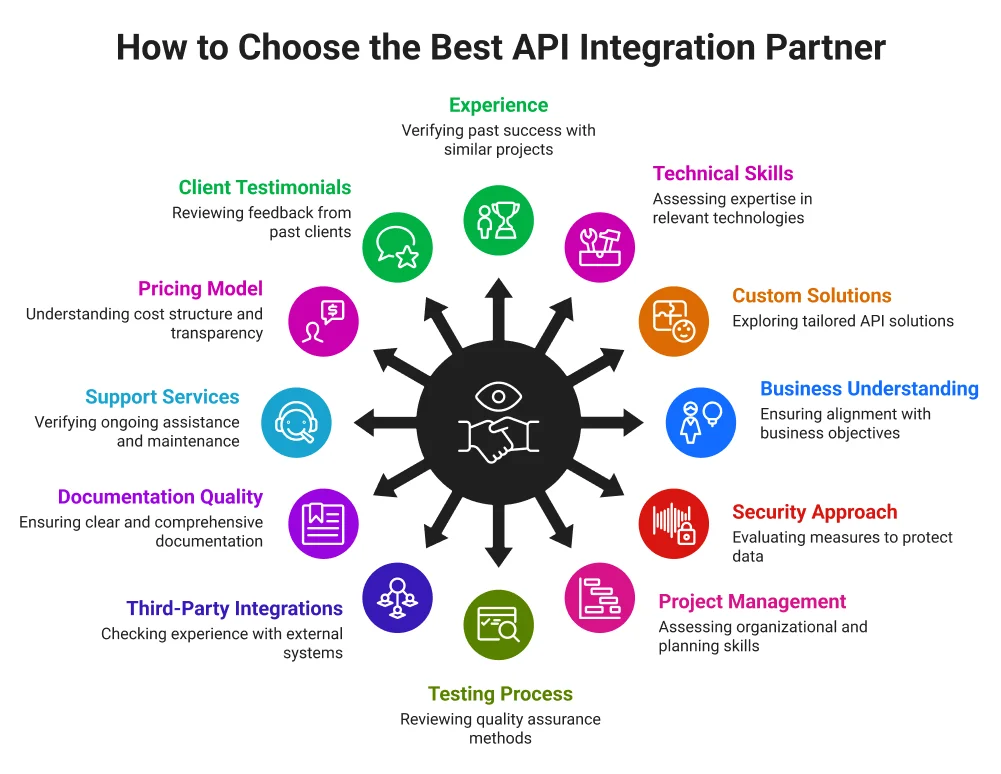
7. Review Their Testing and QA Process
Testing plays a big role in API success. A strong partner will test every part of the integration – functionality, performance, edge cases, and security vulnerabilities.
They should also provide bug reporting and a clear process for fixes.
8. Look for Experience in Third-Party Integrations
If you’re connecting platforms like CRM, ERP, payment gateways, eCommerce systems, or communication tools, the partner must know how these systems work.
Their experience in API integration services lets them solve compatibility challenges smoothly.
9. Check Documentation Quality
Good documentation ensures long-term support and easy maintenance.
Your partner should create clear API guides, flow diagrams, and user instructions so your in-house team can manage updates in the future.
10. Verify Their Support and Maintenance Services
Integrations usually need updates – API versions change, new security rules appear, and platforms evolve.
Make sure the partner provides ongoing support and is available to fix issues quickly after deployment.
11. Understand Their Pricing Model
Look for transparency in pricing. Whether they charge per hour, per project, or via a subscription model, the cost should match the complexity of your integration.
A trustworthy partner will explain everything upfront without confusing jargon.
12. Check Reviews, Ratings, and Client Testimonials
Before selecting the Best API Integration Partner, always check what past clients have to say.
Reviews will give you honest insights into their strengths, weaknesses, communication style, and reliability.
As you evaluate partners, it also helps to revisit your own integration checklist to ensure you’re clear about what your business needs and what expectations you should set from the beginning. This simple step can make the selection process even smoother and help you avoid confusion during the project.
Final Thoughts
Finding the Best API Integration Partner doesn’t have to be complicated. With this API integration checklist, you can evaluate potential partners in a structured and stress-free way.
Focus on experience, technical skills, communication, security, and long-term support—and you’ll set the foundation for smooth, scalable digital solutions.
Whether you need integration for your product, internal systems, or external tools, choosing the right partner ensures your business runs more efficiently and grows faster.
If you’re ready to streamline your systems and need expert guidance, our team can help you plan the right integration approach for your business.

Nihal Rajput is the Operations Director at Ficode Software Solutions Pvt. Ltd., where he oversees day-to-day operations, streamlines processes, and drives organisational efficiency. With a focus on delivering scalable solutions and maintaining operational excellence, he plays a key role in aligning teams, optimising resources, and ensuring client satisfaction as the company grows.

 Previous
 Next
Next