



Jan
Mobile App Development in 2026: Trends, Tools, and Technologies Shaping the Future
The world of mobile app development is experiencing a transformative phase as we progress into 2026. The convergence of artificial intelligence, advanced frameworks, and evolving user expectations is redefining how applications are built and deployed. At Ficode, we’ve observed how the industry has shifted from basic utility apps to sophisticated ecosystems that integrate seamlessly with users’ daily lives.
Understanding the current app development trends 2026 is essential for businesses and developers looking to create products that truly resonate with their audience and stand out in an increasingly competitive marketplace.
Key Trends Transforming Mobile App Development
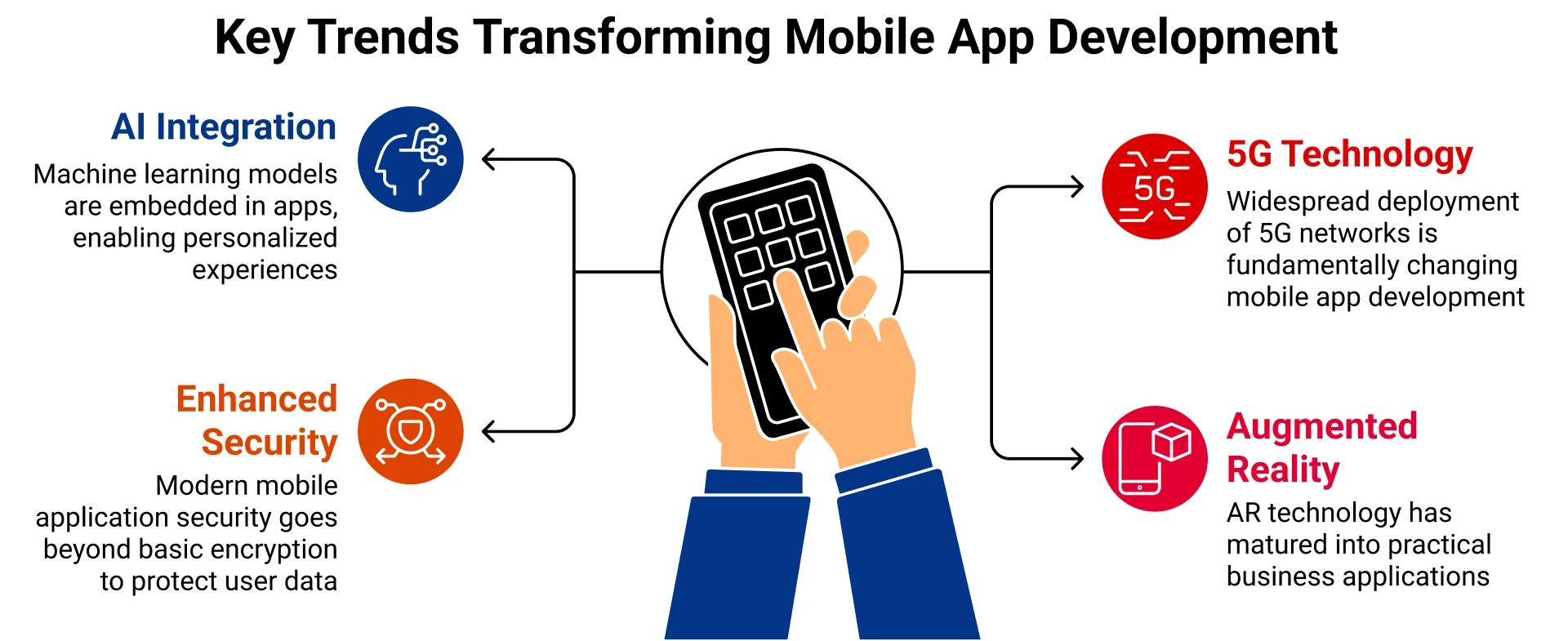
1. Artificial Intelligence Integration
AI has transitioned from an experimental feature to a fundamental component of modern applications. Machine learning models are now being embedded directly into apps, enabling personalized experiences that adapt to individual user behaviours.
AI applications in mobile apps:
- Natural Language Processing – Chatbots and voice assistants understand context
- Image Recognition – Apps identify objects and text in real-time
- Predictive Analytics – Applications anticipate user needs
- Personalization Engines – Content adapts to individual preferences
- Automated Content Generation – AI creates text and summaries on-demand
The democratization of AI tools has made this technology accessible to developers of all skill levels, driving innovation across all app categories.
2. 5G Technology Revolution
The widespread deployment of 5G networks is fundamentally changing what’s possible in mobile app development. With speeds up to 100 times faster than 4G and dramatically reduced latency, developers can create experiences that require real-time synchronization.
5G-enabled features:
- Cloud Gaming – Stream console-quality games without downloading
- AR/VR Experiences – Complex 3D rendering with minimal lag
- Real-time Collaboration – Instant synchronization across multiple users
- 4K Video Streaming – Ultra-high-definition content delivery
- IoT Integration – Seamless connectivity with thousands of devices
3. Enhanced Security and Privacy
Data breaches have made users increasingly conscious of how their information is collected and used. Modern mobile application security goes beyond basic encryption to protect user data comprehensively.
Essential security measures:
- End-to-End Encryption – Protect data in transit and at rest
- Biometric Authentication – Fingerprint and facial recognition
- Two-Factor Authentication – Extra security layers
- Privacy-by-Design – Collect only essential data
- Regular Security Audits – Identify vulnerabilities proactively
4. Augmented Reality Goes Mainstream
AR technology has matured from novelty features into practical business applications, with improving smartphone capabilities making implementation more accessible.
Practical AR applications:
- Retail – Virtual try-ons for clothing and accessories
- Home Design – Visualize furniture before purchasing
- Education – Interactive 3D models for learning
- Navigation – Real-world directions overlaid on camera views
- Healthcare – Surgical planning and training simulations
Essential Tools and Frameworks
Cross-Platform Development
Cross-platform app development has matured significantly, offering compelling alternatives to traditional native development. The ability to maintain a single codebase while deploying to both iOS and Android dramatically reduces costs and time-to-market.
Leading frameworks:
Flutter:
- Near-native performance with smooth animations
- Extensive widget library with customization
- Hot reload for instant development feedback
- Strong Google backing and community
React Native:
- Leverage JavaScript and React expertise
- Massive ecosystem of third-party packages
- Easy integration with native code
- Used by Facebook, Instagram, Airbnb
Kotlin Multiplatform:
- Share business logic, keep native UI
- Full native performance
- Seamless Android integration
Native Development
Despite cross-platform growth, native app development using Swift for iOS and Kotlin for Android remains important for applications requiring maximum performance and deep platform integration.
Modern native advantages:
- SwiftUI and Jetpack Compose for declarative UI
- Direct access to latest OS features
- Optimal performance and battery efficiency
- Platform-specific design guidelines
Backend and Cloud Services
Modern mobile app technologies require robust backend infrastructure for data storage, authentication, and business logic.
Top cloud platforms:
- Firebase – Real-time database, authentication, analytics
- AWS Amplify – Scalable serverless architecture with comprehensive services
- Microsoft Azure – Enterprise-grade security and compliance
Best Practices for Success
Prioritize User Experience
Successful applications begin with deep understanding of target users. Interface design should prioritize clarity and simplicity.
UX essentials:
- Conduct thorough user research and testing
- Create intuitive navigation patterns
- Design for accessibility from the start
- Maintain consistent design elements
- Provide immediate feedback for actions
Optimize Performance
Performance directly impacts user satisfaction and retention. Applications must launch quickly and respond immediately to interactions.
Optimization strategies:
- Implement code splitting and lazy loading
- Compress and cache images effectively
- Minimize API calls and network requests
- Test on various devices and OS versions
- Monitor performance metrics continuously
Implement Comprehensive Testing
Quality assurance is essential in professional mobile app development, ensuring applications work reliably across different scenarios.
Testing approaches:
- Unit testing for individual components
- Integration testing for feature interactions
- End-to-end testing for complete workflows
- Beta testing with real users
- Performance and security testing
Monetization Strategies
Subscription Models
Subscription-based revenue provides predictable income while encouraging continuous product improvement.
Key elements:
- Tiered pricing with different feature levels
- Free trials to reduce barriers
- Annual discounts for longer commitments
- Regular updates justifying ongoing costs
In-App Purchases
Effective for games and productivity apps where users benefit from additional content or features.
Purchase types:
- Consumable items (virtual currency, power-ups)
- Non-consumable features (permanent unlocks)
- Premium content (levels, templates, assets)
Strategic Advertising
Balance revenue with user experience by implementing non-intrusive ad formats.
Best practices:
- Place banner ads at natural break points
- Offer rewarded video ads for value exchange
- Provide ad-free premium alternatives
- Maintain quality standards for advertisements
Overcoming Common Challenges
Platform Fragmentation
Device diversity remains challenging, particularly with Android’s thousands of device models running various OS versions.
Solutions:
- Implement responsive design for different screens
- Establish minimum supported OS versions
- Test on representative device matrix
- Use feature detection rather than assumptions
Market Competition
With millions of apps available, achieving visibility requires strategic App Store Optimization (ASO).
ASO essentials:
- Optimize keywords in title and description
- Create compelling icon and screenshots
- Encourage positive user reviews
- Update regularly to signal active development
Continuous Learning
The rapid pace of change in app development frameworks demands ongoing education. At Ficode, we emphasize continuous learning as core to our development culture.
Stay current through:
- Online courses and official documentation
- Developer communities and conferences
- Open-source contributions
- Experimentation with new technologies
Looking Ahead
As we look beyond 2026, emerging technologies will continue shaping mobile app development:
Future innovations:
- Ambient Computing – Seamless experiences across all devices
- Advanced Biometrics – Voice and behavioural authentication
- Quantum Computing – Revolutionary problem-solving capabilities
- Sustainability Focus – Energy-efficient coding practices
- Neural Interfaces – Brain-computer interaction possibilities
Conclusion
Mobile app development in 2026 represents an exciting convergence of mature technologies and emerging innovations. Success requires balancing technical excellence with user-cantered design, staying current with app development trends 2026, and maintaining adaptability as the landscape evolves.
At Ficode, we believe the future belongs to developers and businesses that embrace continuous learning, prioritize user experience, and remain flexible as technologies advance. Whether you’re building consumer apps or enterprise solutions, focus on delivering genuine value using powerful mobile app technologies available today.
Key takeaways:
- Leverage AI and 5G for enhanced functionality
- Choose appropriate frameworks for your needs
- Prioritize security and user privacy
- Optimize performance across devices
- Implement sustainable monetization strategies
- Stay current with emerging technologies
The possibilities are limitless for those willing to innovate and persevere. The tools and knowledge available today make this an exceptional time to be building for mobile platforms. The future is mobile, and that future is being written right now.

Nihal Rajput is the Operations Director at Ficode Software Solutions Pvt. Ltd., where he oversees day-to-day operations, streamlines processes, and drives organisational efficiency. With a focus on delivering scalable solutions and maintaining operational excellence, he plays a key role in aligning teams, optimising resources, and ensuring client satisfaction as the company grows.
 Previous
 Next
Next