



Jan
What is API Integration & Why Your Business Needs It

In today’s fast-moving digital world, customers expect smooth, fast, and connected experiences. Whether it’s booking a cab, making an online payment, or tracking an order, everything works because different systems communicate with each other in the background. This connection happens through something called API Integration.
Businesses of all sizes – startups, SMEs, and enterprises, depend on reliable communication between software systems. And API Integration has now become one of the most important ways to achieve that. But what exactly does it mean, and why is it so essential for modern businesses?
What is API Integration?
To understand API Integration, let’s first look at what an API is.
API stands for Application Programming Interface – a set of rules that allows one software application to interact with another. Think of it as a bridge that helps two different systems “talk” to each other.
Now, API Integration refers to connecting two or more software applications through their APIs, so they can exchange data quickly and automatically. This means businesses don’t have to manually move information from one system to another. Everything happens in real time, with accuracy and speed.
For example:
- When an eCommerce store shows live shipping rates from couriers.
- When a travel site displays flight availability from multiple airlines.
- When a mobile app uses Google Maps to show your location.
All of these happen because of API Integration working silently in the background.
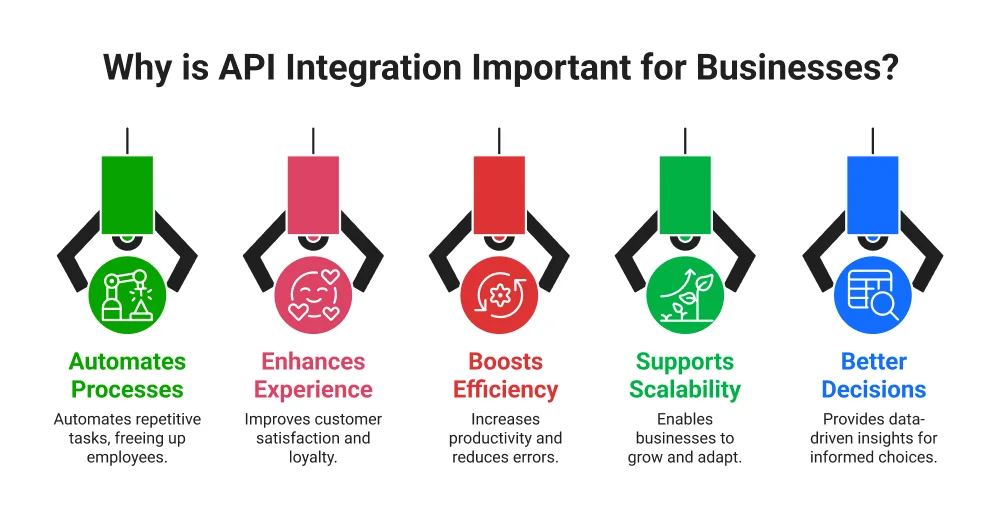
Why is API Integration Important for Businesses?
Modern businesses use different tools for marketing, finance, communication, project management, customer support, and more. Without integration, these tools work in isolation. That results in data silos, slower processes, and extra manual work.
Here are some key reasons why companies cannot afford to ignore API Integration anymore:
1. Automates Manual Processes
One of the biggest benefits of API Integration is automation. Instead of entering the same data into multiple systems, APIs allow that data to move automatically. This reduces human errors, saves time, and improves productivity.
For example, when a customer places an order, the details can instantly flow to inventory, billing, and shipping systems without any manual effort.
2. Enhances Customer Experience
Today, customer experience is everything. Whether you run a software product, an eCommerce store, or a financial service, users expect instant results.
API Integration helps deliver real-time data, faster responses, and smoother navigation.
A simple example is real-time payment status updates or live order tracking—both powered by APIs.
3. Boosts Team Efficiency
When systems are connected, teams don’t have to switch between multiple tools or search for information in different places. Departments such as marketing, sales, HR, and operations can work more efficiently because the information they need is available instantly and accurately.
4. Supports Business Scalability
As businesses grow, they adopt new tools, platforms, or software. Without integration, scaling becomes complicated.
With professional API Integration Services, companies can easily connect new tools with their existing systems, making expansion smoother and more cost-effective.
This flexibility allows businesses to innovate faster and stay competitive.
5. Helps Businesses Make Better Decisions
When systems share data through API Integration, businesses get a unified view of their operations. This makes it easier to analyze performance, identify trends, and make informed decisions.
For example:
- Sales data from CRM
- Marketing performance from analytics tools
- Customer data from support platforms
All can be combined to build a complete picture of the business.
How API Integration Drives Business Growth
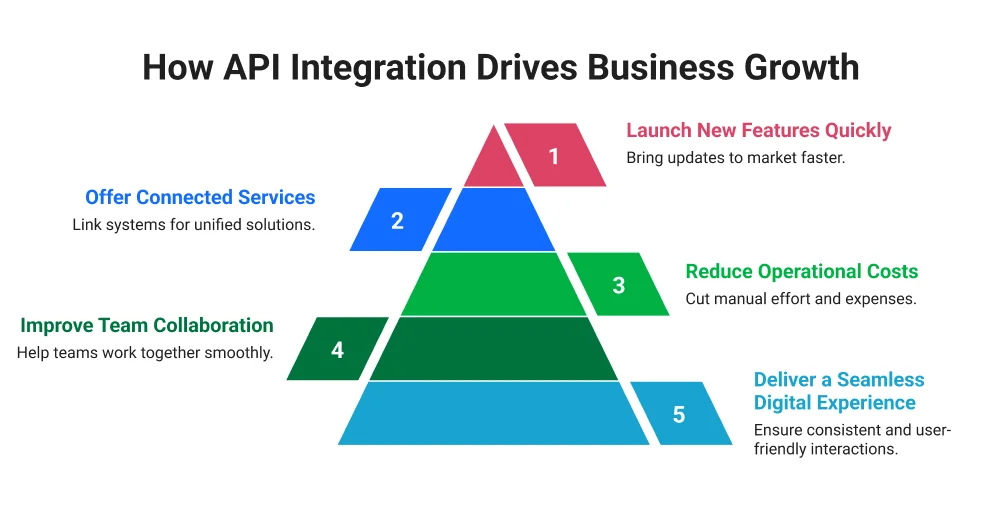
Every organization today wants to improve speed, efficiency, and customer satisfaction. That’s where API for Business Growth comes into the picture.
API Integration helps businesses:
- Launch new features quickly
- Offer connected services
- Reduce operational costs
- Improve team collaboration
- Deliver a seamless digital experience
Whether you’re a service-based company, SaaS platform, eCommerce store, or enterprise, API Integration plays a direct role in strengthening your technology ecosystem.
Do You Need API Integration?
If your business uses more than one software system, the answer is almost always yes.
You need API Integration if:
- Employees are doing repetitive tasks manually
- Systems are not sharing information with each other
- Customers expect faster and more connected services
- You want to scale without technical limitations
- You want accurate, real-time data for decision-making
At the end of the day, API Integration is not just a technical upgrade—it’s a strategic investment that improves efficiency, strengthens customer experience, and supports long-term growth.
Conclusion
API Integration has become essential for businesses that want to stay competitive in the digital era. It connects systems, automates workflows, and ensures that data flows seamlessly across platforms. With the help of expert API Integration Services, companies can unlock better performance, higher productivity, and improved customer satisfaction.
Whether you’re a startup or an established enterprise, now is the right time to explore the power of API Integration and use it as a smart driver for business growth.

Nihal Rajput is the Operations Director at Ficode Software Solutions Pvt. Ltd., where he oversees day-to-day operations, streamlines processes, and drives organisational efficiency. With a focus on delivering scalable solutions and maintaining operational excellence, he plays a key role in aligning teams, optimising resources, and ensuring client satisfaction as the company grows.

 Previous
 Next
Next