

Jan
API Integration vs Custom Development: What’s Best for Your Business?

As businesses scale, they often need software systems that work together smoothly, automate tasks, and deliver better experiences. When upgrading their tech stack, most companies compare two options: API integration or custom development.
Both approaches can solve business challenges, but the right choice depends on your goals, budget, and long-term plans. Let’s break down the differences, along with the pros and cons, cost comparison, and when each option makes the most sense.
What Is API Integration?
API integration connects two or more software applications so they can exchange data or features. Many tools offer ready-to-use APIs such as payment gateways, CRM systems, email services, or communication tools.
This is one reason API integration for businesses has become so common – it gives quick access to powerful features without building them from scratch.
For example, integrating a payment gateway like Stripe allows you to accept online payments without building a payment system from scratch. This is why API integration for businesses has become so popular – it saves time, reduces costs, and provides immediate functionality.
What Is Custom Development?
Custom development means building a solution entirely from scratch based on your specific business needs. Instead of relying on pre-built APIs or third-party tools, you get a fully custom-built solution that gives you complete control over features, user experience, scalability, and security.
Custom development is ideal when your business has unique workflows, operates in a niche industry, or requires capabilities that off-the-shelf tools can’t provide.
Pros of API Integration
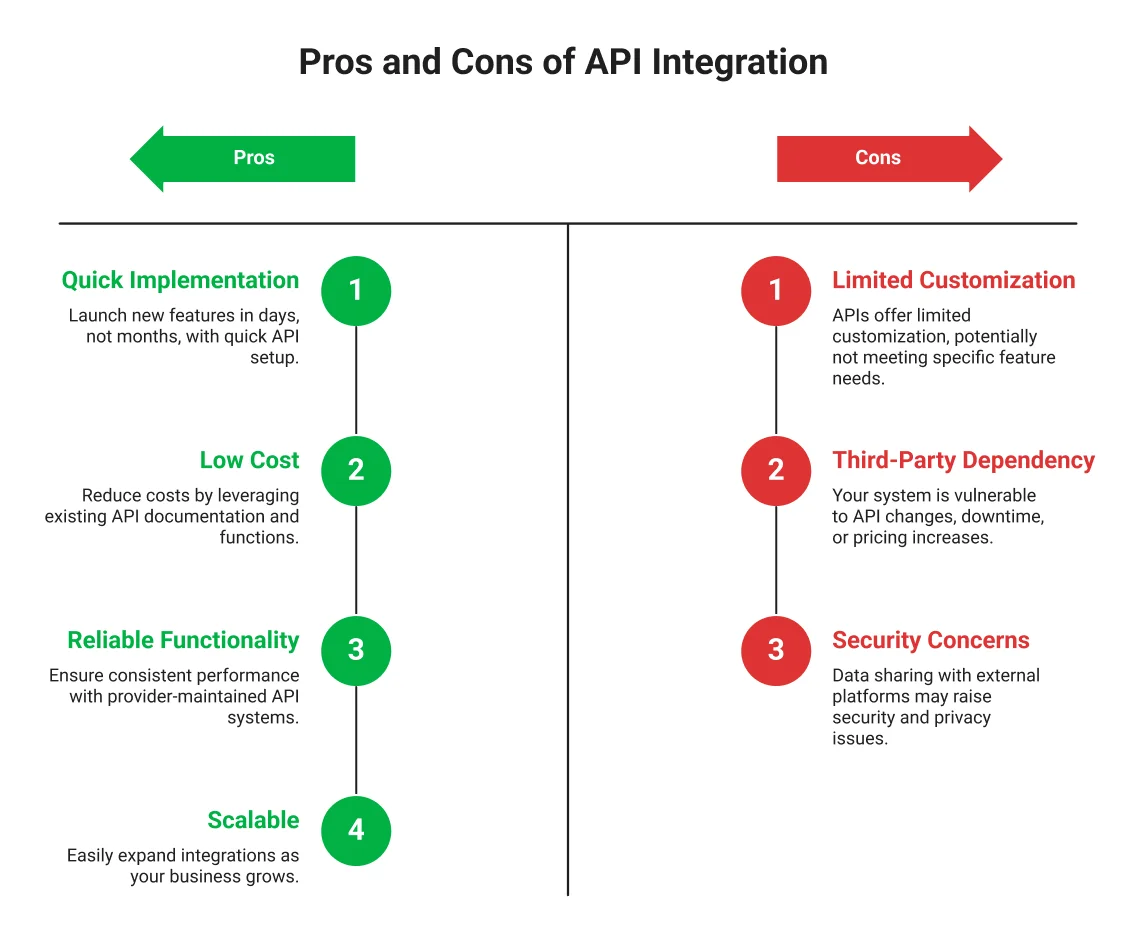
API integration can be extremely powerful for businesses looking to scale quickly without overspending. Here are some of the top benefits:
1. Quick to Implement
API integrations are typically quicker to set up because the core functionality already exists. Your team simply connects your system to a third-party solution.
This means you can launch new features such as notifications, payments, or scheduling – in days instead of months.
2. Low Upfront Cost
You don’t need to build anything from scratch. Most APIs offer documentation and standard functions, making setup easier and cheaper.
3. Reliable Functionality
API providers actively maintain their systems to ensure consistent performance and reliability. This typically includes automatic updates, regular bug fixes, performance improvements, and security patches handled by the provider.
As a result, businesses gain access to stable, well-tested features without needing to manage ongoing maintenance themselves, making API integration for businesses a dependable and low-effort solution.
4. Scalable and Easy to Expand
Businesses can start small and add more integrations over time as they grow.
Cons of API Integration
1. Limited Customization
APIs only allow what the provider offers. If you need very specific features, APIs may not meet your requirements.
2. Dependency on Third Parties
If the API changes, experiences downtime, or increases pricing, your system is affected.
3. Security and Privacy Concerns
Sharing data with external platforms may not work for businesses with strict compliance needs.
Pros of Custom Development
While API integration has many advantages, it’s not always the best choice. In some scenarios, custom development offers a much better long-term return on investment.
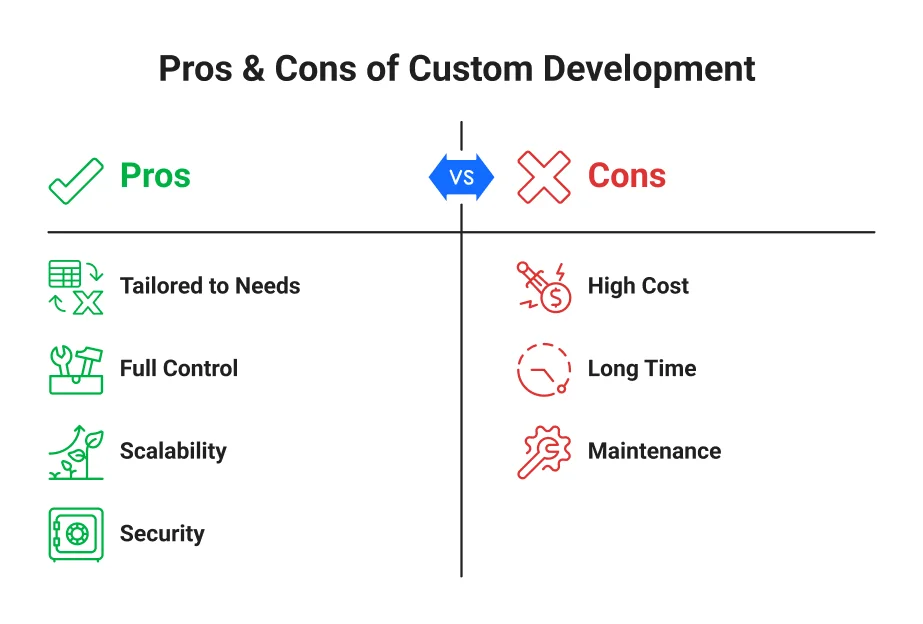
1. Tailored to Your Needs
A custom-built solution works exactly the way your business operates—no compromises.
2. Full Control Over Features
You decide how the system functions, looks, and evolves over time.
3. Better Long-Term Scalability
Custom solutions grow with your business. You can add features based on your strategy, not the limitations of a third-party tool.
4. Stronger Security Options
For industries like healthcare or finance, owning the entire system can reduce external risks.
Cons of Custom Development
1. Higher Initial Investment
Since you’re building from scratch, development costs are higher upfront.
2. Longer Development Time
Custom projects take weeks or months to design, build, and test thoroughly.
3. Requires Ongoing Maintenance
Updates, improvements, and bug fixes need to be managed by your development team.
Cost Comparison: API Integration vs Custom Development
API Integration Costs
- Lower development cost
- Faster implementation reduces labor hours
- Ongoing subscription or usage charges depend on API provider
- Additional costs if API limits increase or pricing changes
Best for: Businesses with limited budget or those testing new features.
Custom Development Costs
- Higher initial investment (design, development, testing)
- Long-term ownership reduces external fees
- No dependency on third-party pricing
- Maintenance costs apply but are more predictable
Best for: Businesses looking for long-term value and full ownership.
When to Choose Which Approach
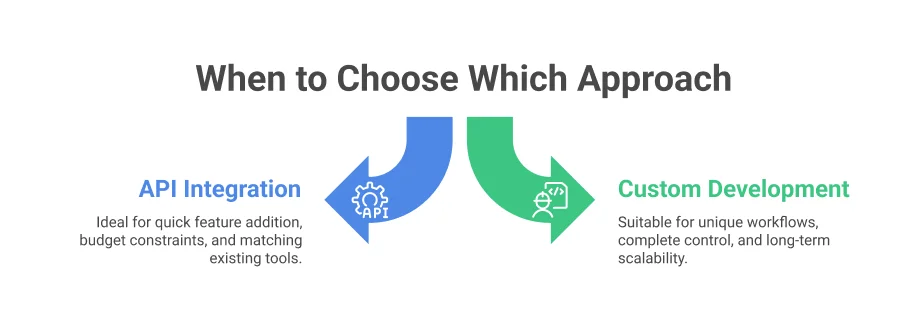
Knowing when to choose API integration vs custom development can help you avoid unnecessary expenses and delays. Here’s a clear guide:
Choose API Integration When –
- You need a feature quickly (payments, messaging, CRM, tracking, etc.)
- Your budget is limited
- Your needs match existing tools
- You want to test an idea before investing heavily
- You prefer ready-made, reliable solutions
APIs are perfect for adding features fast without rebuilding your entire system.
Choose Custom Development When –
- Your business has unique workflows or industry-specific needs
- You need complete control over your software
- Data privacy and security are high priorities
- You want a long-term, scalable solution
- External API limitations hold you back
A custom-built solution is the best choice when you want full flexibility and a system designed around your business.
Finding the Right Balance
In many cases, the best solution is a combination of both. For example, a business might build a custom platform but integrate third-party APIs for features like analytics, maps, or communication.
This hybrid approach gives you the flexibility of custom development with the speed and cost benefits of API integration.
Conclusion
Both API integration and custom development offer powerful benefits – but the right choice depends on your business goals, budget, and long-term vision.
If you need quick, cost-effective functionality, API integrations are a great option. If you want full control, scalability, and personalization, custom development delivers better long-term value. In many cases, businesses achieve the best results by combining both approaches – using custom-built solutions for core systems while leveraging APIs for faster access to specialized features.
Ready to Build the Right Solution for Your Business?
Whether you’re exploring API integration or planning a custom-built system, our team can help you choose the best approach.
Contact us today to get expert guidance and start your project with confidence!

Nihal Rajput is the Operations Director at Ficode Software Solutions Pvt. Ltd., where he oversees day-to-day operations, streamlines processes, and drives organisational efficiency. With a focus on delivering scalable solutions and maintaining operational excellence, he plays a key role in aligning teams, optimising resources, and ensuring client satisfaction as the company grows.

 Previous
 Next
Next