



Apr
The True Cost of API Integration in 2026: A Complete Pricing Guide

In 2026, API integration has become a core requirement for businesses aiming to automate workflows, improve customer experiences, and streamline data exchange across platforms. Whether you’re connecting a CRM with your website, integrating payment systems, or building custom workflows using AI-driven APIs – understanding the real cost of API integration is essential for budgeting and planning.
API integration is no longer a simple development task. Today, it involves architecture planning, security implementation, testing, documentation, and ongoing maintenance. This guide breaks down the true cost of API integration in 2026, what factors influence pricing, and how businesses can choose the most cost-effective solution.
What Is API Integration?
API integration refers to connecting two or more software applications so they can communicate and exchange data seamlessly. This can range from basic plug-and-play connections to advanced, custom-built integrations that connect multiple business systems like CRM, ERP, eCommerce platforms, payment gateways, logistics providers, and internal tools.
In 2026, businesses are leveraging APIs more than ever to build connected digital ecosystems – which is also why pricing has evolved.
Average Cost of API Integration in 2026
API integration cost depends on complexity, API type, data flow, and development expertise. The table below gives a clear breakdown of pricing, timelines, and associated risks:
| Integration Type | Example Use Cases | Estimated Timeline | API Integration Cost | Typical Risks |
| Simple API Integration | Contact form to CRM, payment gateway setup, basic third-party API connections, analytics or authentication APIs | 1-2 weeks | $1,500 – $5,000 | Limited scalability, basic security gaps, dependency on third-party APIs |
| Moderate API Integration | eCommerce inventory sync, booking systems, shipping/logistics APIs, multi-step automation workflows, role-based authentication | 2-6 weeks | $5,000 – $15,000 | Data sync errors, performance issues, increased testing complexity |
| Complex API Integration | ERP-CRM integration, custom API development, AI-driven workflows, fintech/healthcare systems, legacy system integration | 6-16+ weeks | $15,000 – $50,000+ | High development cost, security vulnerabilities, integration failures, maintenance overhead |
| Enterprise API Integration | Multi-system integrations, large databases, compliance-heavy systems (PCI, HIPAA), multi-cloud environments | 3-6+ months | $50,000 – $100,000+ | Compliance risks, scalability challenges, high maintenance cost, system downtime risks |
The overall API integration cost increases with complexity, number of endpoints, real-time processing, and security requirements.
Top Factors That Influence API Integration Cost
1. Type of API
There are three major types of APIs businesses use in 2026:
- Third-Party APIs (Stripe, Twilio, PayPal, Shopify, Google API)
Lowest cost but limited customisation. - Custom APIs
Higher cost due to engineering effort and architecture planning. - Hybrid API Systems
Combination of both, often used in enterprise setups.
Custom APIs always cost more because they require design, development, testing, and documentation.
2. Number of Endpoints
Endpoints are like “doors” where the system sends or receives data.
- 1-3 endpoints → low cost
- 4-10 endpoints → moderate cost
- 10+ endpoints → high and enterprise-level cost
More endpoints = more development hours = higher cost.
3. Data Flow Complexity
Costs increase based on:
- Real-time vs batch data updates
- Single-direction vs bi-directional syncing
- Volume of data
- Need for data transformation
- Frequency of API calls
Real-time syncing always raises the cost.
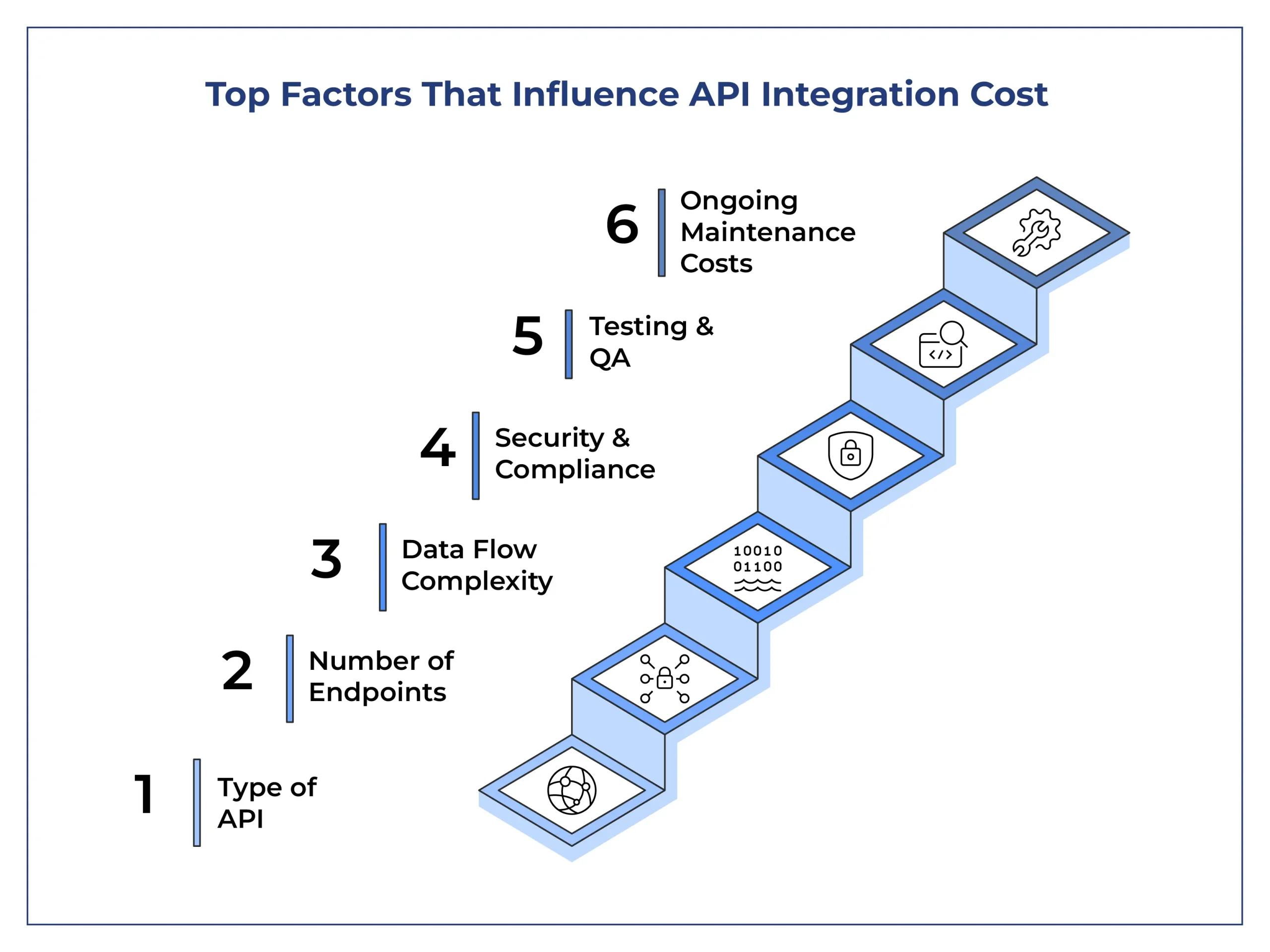
4. Security & Compliance
APIs must follow strong security protocols, especially in 2026 where cyberattacks have increased.
Security features that add to the cost:
- OAuth, JWT authentication
- Encryption
- Role-based access
- Rate-limiting
- Compliance standards (PCI, HIPAA, GDPR)
More security = more development = higher budget.
5. Testing & QA
Testing often takes 30-40% of the total development time.
It includes:
- Unit testing
- Integration testing
- Load testing
- Sandbox testing
- Error and exception handling
Better testing reduces long-term maintenance costs.
6. Ongoing Maintenance Costs
API integration is not a one-time activity.
Maintenance includes:
- Version upgrades
- Fixing deprecated endpoints
- Monitoring logs
- Improving error handling
- Scaling for performance
Annual maintenance usually costs 15%-25% of the total integration price.
Why API Integration Costs Are Increasing in 2026
Several trends are contributing to higher pricing:
- More platforms shifting to AI-driven APIs
- Businesses adopting microservices and multi-cloud architectures
- Complex user expectations for personalisation
- Higher security and privacy requirements
- More demand for real-time data processing
While costs have increased slightly, the ROI has increased even more due to better automation and business intelligence.
How to Reduce API Integration Costs
Here are practical ways to save money:
- Use existing third-party APIs instead of building from scratch
- Choose modern platforms with ready API libraries
- Standardise your data formats
- Avoid unnecessary features in early stages
- Work with experienced API developers (fewer errors, less rework)
- Plan a well-structured API architecture
Good planning can reduce costs by 20-30%.
Conclusion
The cost of API integration in 2026 depends on multiple variables including API type, complexity, security requirements, and long-term maintenance. On average, businesses can expect to spend anywhere from $1,500 to $50,000+ depending on their integration needs.
While API integration may seem like a significant investment, the long-term benefits — automation, efficiency, reduced manual tasks, and improved customer experience — make it crucial for modern businesses.

Nihal Rajput is the Operations Director at Ficode Software Solutions Pvt. Ltd., where he oversees day-to-day operations, streamlines processes, and drives organisational efficiency. With a focus on delivering scalable solutions and maintaining operational excellence, he plays a key role in aligning teams, optimising resources, and ensuring client satisfaction as the company grows.

 Previous
 Next
Next